
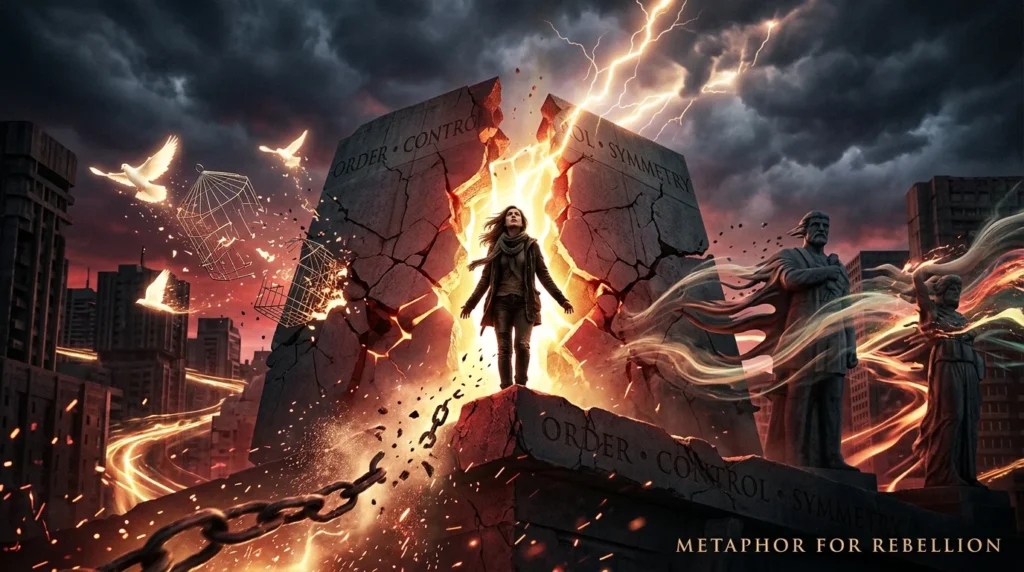
Sometimes you want to describe rebellion, but the word itself feels too plain. You want fire, movement, and emotion in your writing. That’s when people search for a metaphor for rebellion—because they need images that feel alive, not just definitions.
Think about a student quietly pushing back against strict rules, or a story character refusing to follow a path everyone expects. Writers often struggle here. They know what rebellion means, but not how to show it in a creative way. That confusion is very common, especially in school writing and poetry.
Here’s the simple truth: rebellion is rarely just “anger.” It’s energy, pressure, breaking limits, and sudden change. So metaphors help us turn that invisible emotion into something we can see—like storms, fire, or cracking walls.
Let’s explore how rebellion becomes language you can feel.
What Is a Metaphor for Rebellion?
A metaphor for rebellion is a figurative expression that compares rebellion to something powerful, physical, or symbolic without using “like” or “as.”
Simple definition (featured snippet):
A metaphor for rebellion is a creative comparison that shows rebellion as a force, object, or image that represents resistance, freedom, or breaking control.
Writers use it because rebellion is abstract. You can’t touch it. So they turn it into imagery that readers can see and feel.
Why writers use it:
- To show emotional intensity
- To create strong visual language
- To make abstract ideas easier to understand
- To add poetic depth in stories or essays
Real-world meaning:
Rebellion in writing often represents:
- Freedom
- Resistance
- Identity
- Change
- Emotional pressure building up
Quick List of Metaphor for Rebellion Examples
Here are easy, copy-ready metaphors with meanings:
- A breaking dam — emotions or rules collapsing
- A wildfire in silence — hidden rebellion spreading
- A storm inside a cage — trapped anger growing
- Cracks in a glass kingdom — authority becoming weak
- A rising underground river — quiet resistance building
- Thunder under skin — emotional unrest
- A bird snapping its chains — desire for freedom
- Volcanic pressure — rebellion about to erupt
- A shadow learning to stand — hidden identity awakening
- Knives of truth — sharp rejection of control
- A locked door shaking — desire to escape
- Ashes refusing to stay dead — rebellion after defeat
- A flickering revolution — unstable but alive resistance
- Lightning without warning — sudden defiance
- A broken compass — rejecting direction or authority
- Fire rewriting the map — changing the system
- A whisper turning into a roar — small resistance becoming loud
- Ice melting into motion — control dissolving
Beautiful Metaphors for Rebellion
Some metaphors feel more emotional and artistic. These are often used in poetry and storytelling.
Rebellion as fire:
- “Rebellion was a candle turning into a forest fire.”
Meaning: small discontent growing into unstoppable change.
Rebellion as weather:
- “The town carried rebellion like a storm it could not name.”
Meaning: tension building quietly.
Rebellion as nature breaking limits:
- “The roots of rebellion split through concrete.”
Meaning: natural truth overpowering control.
Rebellion as sound:
- “Silence learned how to scream.”
Meaning: quiet people finally resisting.
Rebellion as movement:
- “The crowd became a wave that refused the shore.”
Meaning: collective resistance.
That tiny change creates a stronger image than simply saying “people rebelled.”
Poetic and Deep Rebellion Ideas
This is where metaphor becomes art.
- “Rebellion slept like embers under polite conversations.”
- “Every rule was a thread pulling tighter around a wild heart.”
- “Freedom knocked softly before it learned to break doors.”
- “The system wore cracks like aging stone.”
- “Their silence was not empty—it was loading thunder.”
In poetic writing, rebellion often becomes:
- Pressure beneath calm surfaces
- Hidden truth waiting to explode
- A voice slowly learning strength
This is where many beginners get confused: rebellion doesn’t always look loud. Sometimes it looks quiet before it becomes powerful.
Rebellion in Creative Writing
Writers use metaphors for rebellion in:
Stories
To show characters breaking rules or systems:
- “She was a spark in a house made of dry paper.”
Poetry
To express emotional resistance:
- “My thoughts marched without permission.”
Descriptive writing
To show tension in scenes:
- “The classroom felt like a storm holding its breath.”
School essays
To make ideas more expressive:
- “Rebellion is the river carving its own path through stone.”
Mini writing example:
The student didn’t speak loudly. But inside, rebellion was a locked engine turning slowly, waiting for fuel.
Metaphor vs Simile
| Feature | Metaphor | Simile |
|---|---|---|
| Meaning | Direct comparison | Uses “like” or “as” |
| Impact | Stronger, deeper | Softer, clearer |
| Example | Rebellion is fire | Rebellion is like fire |
| Emotion | More intense | More descriptive |
| Beginner mistake | Over-complicating | Overusing “like/as” |
Why People Confuse Metaphors and Similes
This is very common for beginners.
- School teaching mixes both together
- Students look for “easy sentence formulas”
- Fear of making grammar mistakes
- Both describe comparisons, so they feel similar
Simple trick:
If you see “like” or “as,” it’s a simile. If not, it’s a metaphor.
Real-Life Conversation Examples
1. Classroom discussion
Teacher: “What does rebellion feel like?”
Student: “It feels like a locked door shaking from inside.”
🎯 Lesson: Emotions can become physical images.
2. Poetry workshop
Student: “My rebellion is a quiet fire.”
Teacher: “That image is strong because it feels hidden but powerful.”
🎯 Lesson: Small metaphors can feel intense.
3. Social media caption
“This silence is not peace—it’s rebellion waiting.”
Friend: “That’s deep.”
🎯 Lesson: Short metaphors can still be powerful.
4. Story writing group
Writer: “The system is a cracked wall.”
Editor: “Good—now I can see it breaking.”
🎯 Lesson: Visual metaphors improve storytelling.
How to Create Your Own Metaphor for Rebellion
Here’s the simple trick:
Step 1: Feel the emotion
Is rebellion quiet, angry, or growing?
Step 2: Choose a strong image
Think:
- fire
- weather
- animals
- machines
- nature
Step 3: Connect them
Turn emotion into image:
- Quiet rebellion → “a sleeping volcano”
- Growing rebellion → “a rising tide”
- Sudden rebellion → “lightning in a locked room”
That tiny shift creates powerful writing.
Common Mistakes Beginners Make
- Using too many metaphors in one sentence
- Choosing weak images (like “chair” or “table”)
- Mixing metaphors randomly
- Forgetting emotional meaning
- Overwriting instead of showing clarity
Correct example:
✔ “Rebellion was a storm behind his eyes.”
Incorrect:
✘ “Rebellion was a chair of storm fire emotion.”
Related Figurative Language Terms
- Simile — comparison using like/as
- Imagery — language that creates pictures
- Personification — giving human traits to objects
- Symbolism — deeper meaning behind objects
- Hyperbole — extreme exaggeration
Frequently Asked Questions
What is a simple metaphor for rebellion?
Rebellion is a fire that refuses to die.
How do you describe rebellion in writing?
Use strong images like storms, fire, or breaking chains.
What is a poetic metaphor for rebellion?
“Rebellion is a quiet thunder building under silence.”
Can rebellion be shown as nature?
Yes, like rivers breaking stones or storms forming.
Why use metaphors for rebellion?
They make emotions visible and more powerful.
What is a strong symbol for rebellion?
Fire, lightning, breaking chains, or rising waves.
Literary Insight: Rebellion in Writing
In literature, rebellion often appears as fire, storm, or breaking structures. Writers use it to show transformation—when characters refuse control and choose their own path.
From classic novels to modern poetry, rebellion metaphors help readers feel change instead of just reading about it.
Conclusion
Rebellion is more than just breaking rules. In writing, it becomes a living image—fire under silence, storms inside calm faces, and cracks forming in old systems. When you use a strong metaphor for rebellion, you turn simple ideas into emotional experiences.
The best writers don’t just say rebellion exists—they make it visible. They let readers see it, feel it, and remember it. Start small, use clear images, and let your imagination build from emotion. That’s where powerful writing begins.