
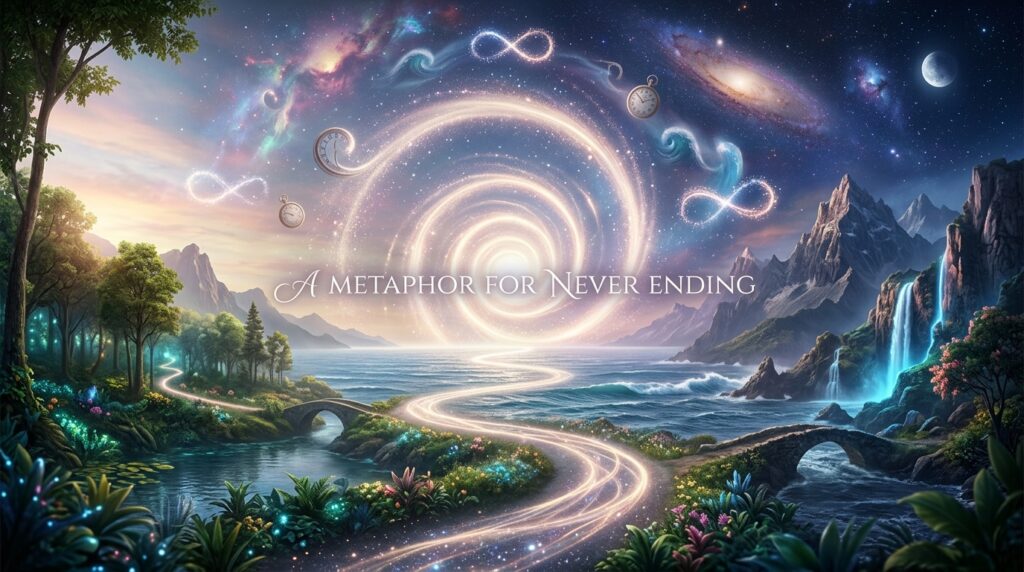
Have you ever tried to describe something that just… doesn’t stop? Like your thoughts before sleep, or the ocean that keeps rolling even after you stop watching it? Writers often struggle with this feeling because ordinary words feel too small.
That’s where a metaphor for never ending becomes powerful. Instead of saying “it lasts forever,” we compare it to something that feels endless in real life—like the sky, the sea, or time itself flowing like water.
People search for this idea when they want to make their writing more emotional, poetic, or meaningful. Students use it in essays. Poets use it in love poems. Storytellers use it to describe time, pain, hope, or even memory.
But here’s the interesting part—there isn’t just one way to show “never ending.” There are many images, each carrying a different emotional color. Some feel peaceful. Some feel heavy. Some feel magical.
Let’s explore them together in a simple, creative way that feels like learning from a patient writing teacher.
What Is a Metaphor for Never Ending?
A metaphor for never ending is a figurative expression that describes something endless by comparing it to something that has no clear end in real life.
Simple definition (featured snippet):
A metaphor for never ending is a comparison that shows something continuing forever without stopping, like time, emotions, or space.
Writers use these metaphors to express feelings that cannot be measured—like love, grief, imagination, or existence.
Think about it this way:
- “Never ending” is an idea
- A metaphor turns it into a picture
Instead of saying:
“Her sadness never ended.”
A writer might say:
“Her sadness was an ocean with no shore.”
That tiny change creates a stronger emotional image.
Quick List of Metaphors for Never Ending Examples
Here are easy, copy-paste-friendly examples with meanings:
- An endless ocean — something vast and continuous
- A road with no horizon — a journey without an end
- A sky without edges — infinite space
- A river that forgets its destination — constant flow without stopping
- A book with no final page — story that never closes
- A clock with broken hands — time that doesn’t end
- A staircase into clouds — endless upward journey
- A circle drawn in light — forever returning loop
- A dream that never wakes — imagination without ending
- A song stuck on repeat in the universe — eternal rhythm
- A candle that never melts away — lasting presence
- A desert that stretches beyond thought — endless emptiness
- A memory carved into forever stone — permanent remembrance
- A universe expanding in silence — infinite growth
- A heartbeat that echoes through time — ongoing life force
- A night that never meets dawn — eternal darkness
- A path made of stars with no end — cosmic journey
- A whisper that circles the world forever — never fading sound
- A story written in invisible ink across time — ongoing narrative
- A waterfall that falls into forever — continuous motion
Beautiful Metaphors for Never Ending
Some metaphors feel soft and emotional. Others feel deep and reflective.
- “Love is an ocean that forgets its shoreline.”
Shows emotional depth that doesn’t stop. - “Time is a river that never learns to pause.”
Suggests unstoppable movement. - “Hope is a candle that refuses to burn out.”
Gives warmth and endurance. - “Memory is a sky that never loses its stars.”
Suggests permanence of the past. - “Life is a spiral staircase with no final step.”
Shows continuous journey and growth.
Here’s the simple trick:
If you want “never ending,” choose something that naturally flows, expands, or repeats.
Poetic and Deep Never Ending Ideas
Now let’s go deeper—this is where writing becomes art.
- “The universe breathing without end.” — cosmic eternity
- “A silence stretching beyond language.” — infinite stillness
- “An echo that outlives sound itself.” — timeless resonance
- “A shadow that never forgets the light.” — emotional duality
- “A thought looping through infinity.” — mental repetition
- “A garden that grows inside forever.” — internal expansion
- “A tear that falls into endless memory.” — emotional depth
These are not just descriptions—they are emotional experiences in words.
Metaphor for Never Ending in Creative Writing
Writers use these metaphors in many ways:
- Stories: to describe journeys that don’t resolve quickly
- Poetry: to express love, grief, or eternity
- Essays: to explain abstract ideas like time or change
- School writing: to improve descriptive language scores
Example in a story:
The city lights stretched like an endless necklace across the dark horizon.
Example in poetry:
Her voice became a river that forgot how to stop flowing.
This is where figurative language—metaphor, simile, imagery, and symbolism—works together to build emotional depth.
Metaphor vs Simile
| Feature | Metaphor | Simile |
|---|---|---|
| Meaning | Direct comparison | Indirect comparison |
| Grammar | “is / was” | “like / as” |
| Emotional impact | Strong and deep | Soft and descriptive |
| Example | Time is a river | Time flows like a river |
| Beginner mistake | Confusing literal meaning | Overusing “like” |
Why People Confuse Metaphors and Similes
This is very common for beginners.
Here’s why:
- School teaches both together
- Both compare things
- Sentence structure looks similar
- Students rely too much on “like” or “is”
Simple fix:
- If you see “like” or “as” → simile
- If you see direct replacement → metaphor
That’s it.
Real-Life Conversation Examples
1. Classroom writing discussion
Student: “Is ‘time is a river’ a metaphor?”
Teacher: “Yes, because it directly says time is a river.”
🎯 Lesson: Metaphors replace meaning directly.
2. Poetry workshop
Writer: “I wrote ‘love is an ocean without end.’”
Teacher: “That creates strong emotional depth.”
🎯 Lesson: Metaphors build emotion through imagery.
3. Social media caption idea
User: “I want something deep for my post.”
Friend: “Try ‘memories are stars that never fade.’”
🎯 Lesson: Metaphors make captions poetic.
4. Storytelling moment
Narrator: “His journey felt endless.”
Editor: “Make it stronger—say ‘his journey was a road without sunrise.’”
🎯 Lesson: Imagery replaces plain description.
How to Create Your Own Metaphor for Never Ending
Here’s the simple creative trick:
- Think of something that repeats (waves, time, breath)
- Add infinity feeling (no end, no stop, no finish)
- Turn it into “X is Y” structure
- Add emotion (peaceful, dark, hopeful)
Example:
- Thought → ocean → “My thoughts are an ocean with no shore.”
That’s all it takes.
Common Mistakes Beginners Make
- Saying “never ending forever” (repetitive meaning)
- Mixing simile and metaphor incorrectly
- Using too many words instead of strong imagery
- Choosing abstract ideas with no visual link
- Forcing poetry instead of letting it flow naturally
Fix: always choose something visual first.
Related Figurative Language Terms
- Simile — comparison using like/as
- Imagery — creating pictures with words
- Personification — giving human traits to things
- Symbolism — using objects to represent ideas
- Hyperbole — extreme exaggeration for effect
All of these work together with metaphors.
Frequently Asked Questions
What is a simple metaphor for never ending?
An endless ocean or a road without a horizon.
How do you write a metaphor for forever?
Compare it to something that repeats or expands, like time, ocean, or sky.
What is the emotional meaning of never ending metaphors?
They show infinity, continuity, or feelings that don’t stop.
Can metaphors for never ending be used in poems?
Yes, they are very common in poetry and emotional writing.
What is the difference between endless and infinite metaphors?
Endless focuses on duration, infinite focuses on size or space.
Why do writers use never ending metaphors?
To express deep emotions that ordinary words cannot capture.
Conclusion
A metaphor for never ending is more than just a writing trick—it’s a way to stretch language beyond its limits. When you compare something endless to oceans, skies, or time itself, your writing becomes more emotional and alive.
You don’t need complex words to sound poetic. You just need the right image and a feeling behind it.
Think of writing as painting with words. And when something feels never ending, paint it big, wide, and flowing—like it refuses to stop even after the sentence ends.