
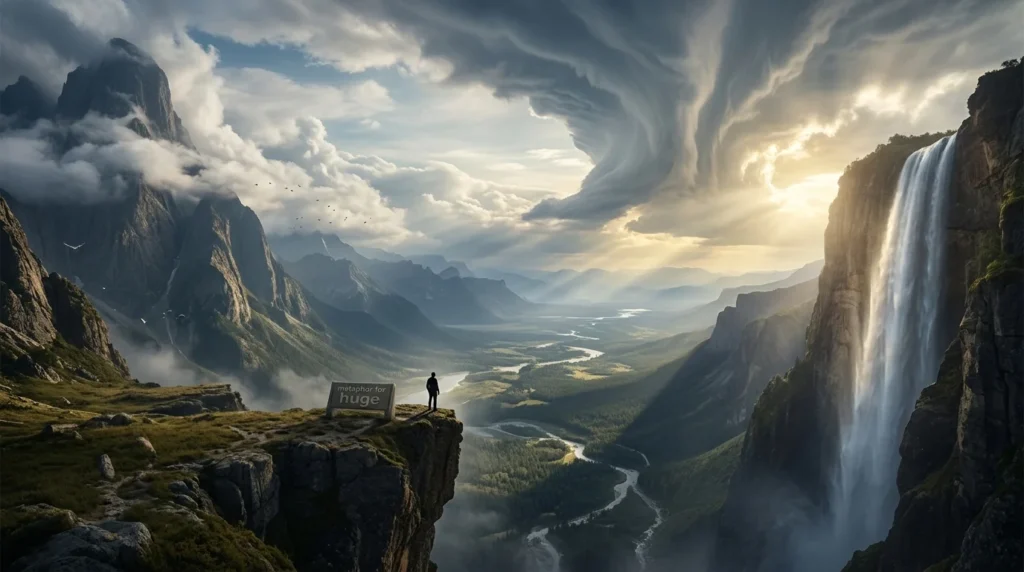
Have you ever written a sentence like “the building was very big” and felt like it sounded flat or boring? That happens to almost every beginner writer. Simple words explain size, but they do not create emotion or imagery.
That is why many people search for a metaphor for huge. They want stronger descriptions. They want readers to feel the size instead of just reading about it.
A good metaphor can turn an ordinary sentence into something vivid and unforgettable. Instead of saying “the wave was huge,” you might say, “The wave was a moving mountain.” That tiny change creates a stronger image.
Writers use metaphors in poems, stories, school essays, songs, captions, and even everyday conversation. They help create emotional imagery, symbolism, and visual language that stays in the reader’s mind.
Here’s the simple trick: the best metaphors compare something huge to something people instantly recognize as massive, endless, powerful, or overwhelming.
And once you start noticing them, you will see giant metaphors everywhere.
What Is a Metaphor for Huge?
A metaphor for huge compares something enormous to another giant or powerful image without using “like” or “as.”
In simple terms, it replaces the word “huge” with vivid figurative language.
Writers use metaphors because they create stronger imagery and emotional impact.
For example:
- “The city was a concrete jungle.”
- “Her anger was a wildfire.”
- “The crowd became an ocean.”
These examples feel alive because they paint pictures in the reader’s mind.
In creative writing, metaphors help readers imagine:
- giant size
- emotional intensity
- overwhelming power
- endless space
- dramatic scale
Most writers use this because plain words rarely create memorable imagery.
Quick List of Metaphor for Huge Examples
- A mountain of problems — something overwhelming
- An ocean of people — a massive crowd
- A giant among men — extremely powerful or important
- A roaring beast — huge and wild
- A walking skyscraper — very tall person or creature
- A tidal wave of emotions — intense feelings
- A planet-sized dream — enormous ambition
- A forest of towers — many tall buildings
- A thundercloud hanging overhead — something heavy and massive
- A whale in shallow water — something too large for the space
- A sleeping volcano — huge hidden power
- A wall of noise — overwhelming sound
- A galaxy of lights — countless shining objects
- A dragon stretching across the sky — giant clouds or storms
- An avalanche of messages — too many messages at once
- A giant shadow over the town — something dominant
- A castle above the clouds — something towering
- A sea without an end — endless size
- A monster of a machine — extremely large equipment
- A titan standing alone — someone huge or powerful
- A river swallowing the land — massive flooding
- A storm eating the horizon — gigantic storm imagery
- A beast made of steel — huge industrial object
- A mountain walking on legs — giant creature
- A sky-sized silence — deep emotional emptiness
Beautiful Metaphors for Huge
Sometimes writers want huge imagery that feels emotional or poetic instead of simple.
Here are beautiful examples with meanings.
“Her love was an endless ocean.”
This metaphor suggests emotional depth, mystery, and something impossible to measure.
“The cathedral stood like a stone giant guarding the city.”
The image feels ancient, powerful, and protective.
“His dreams were galaxies waiting to be explored.”
This creates wonder and limitless possibility.
“The tree spread across the field like a green kingdom.”
Nature symbolism often makes large things feel magical instead of intimidating.
“The storm rolled forward as a hungry beast.”
This adds movement, danger, and emotional imagery.
“The library was a universe of forgotten voices.”
That metaphor feels deep, intelligent, and slightly mysterious.
Poetic and Deep Metaphor for Huge Ideas
Poetic language often turns giant size into emotional symbolism.
Here are deeper examples many writers love.
“Grief became a black ocean without shores.”
This metaphor connects huge space with emotional pain.
“The night opened above them like an endless kingdom.”
Fantasy writers often use sky imagery to express greatness.
“The castle rose from the cliffs like a sleeping titan.”
A titan symbolizes ancient power and giant scale.
“Hope burned inside her like a second sun.”
Huge imagery can also symbolize strength and emotional energy.
“The city breathed like a giant machine.”
This gives the setting life through personification and metaphor together.
“Silence filled the room like a winter sky.”
Think about it this way: huge metaphors do not always describe physical size. They can describe feelings, fear, loneliness, dreams, or pressure too.
Metaphor for Huge in Creative Writing
Creative writers use metaphors to make scenes feel cinematic and emotional.
Here’s where many beginners get confused: metaphors are not just decorations. They help readers experience the story.
In Storytelling
Instead of:
“The dragon was huge.”
Try:
“The dragon blotted out the sky.”
That sentence instantly creates visual language.
In Poetry
Instead of:
“She felt sad.”
Try:
“Sadness wrapped around her like a winter sea.”
Poetry uses imagery to create emotion rather than direct explanation.
In School Assignments
Teachers often look for descriptive writing and literary devices.
Example:
“The stadium erupted into an ocean of noise.”
This sounds stronger than “The stadium was loud.”
In Social Media Captions
Metaphors also make captions more memorable.
Example:
“My to-do list is a mountain today.”
Short. Relatable. Visual.
Metaphor vs Simile
| Feature | Metaphor | Simile |
|---|---|---|
| Meaning | Direct comparison | Comparison using “like” or “as” |
| Grammar | Says something is something else | Says something is like something |
| Emotional Impact | Stronger and deeper | Softer and more obvious |
| Example | “The crowd was an ocean.” | “The crowd was like an ocean.” |
| Beginner Mistake | Mixing comparisons | Forgetting “like” or “as” |
A metaphor feels more powerful because it sounds direct and confident.
Why People Confuse Metaphors and Similes
This is where many beginners get confused.
Both metaphors and similes compare things.
The difference is small, but important.
Similes Use Connecting Words
Words like:
- like
- as
- resembles
Example:
“The cloud looked like a mountain.”
Metaphors Replace One Thing With Another
Example:
“The cloud was a mountain.”
Many students accidentally combine both styles.
Incorrect:
“The cloud was like a mountain giant.”
Correct:
“The cloud was a mountain giant.”
Or:
“The cloud looked like a mountain.”
Keeping the structure simple makes figurative language stronger.
Real-Life Conversation Examples
School Conversation
Ayesha: “How do I describe the giant crowd in my essay?”
Bilal: “Call it an ocean of people.”
🎯 Lesson: Huge metaphors create quick visual imagery.
Poetry Writing
Sara: “My poem feels boring.”
Teacher: “Replace ‘big storm’ with ‘a beast swallowing the sky.’”
🎯 Lesson: Emotional imagery feels more memorable.
Social Media Caption
Friend: “How was the concert?”
You: “It was a tidal wave of sound.”
🎯 Lesson: Metaphors make simple descriptions dramatic.
Storytelling Example
Writer: “The castle was huge.”
Editor: “Try ‘The castle clawed at the clouds.’”
🎯 Lesson: Strong verbs improve metaphor imagery.
Classroom Example
Student: “Can metaphors describe emotions too?”
Teacher: “Absolutely. Fear can become a dark forest.”
🎯 Lesson: Metaphors work for feelings, not just objects.
How to Create Your Own Metaphor for Huge
You do not need to be a professional poet.
Most great metaphors begin with simple observation.
Think About Giant Things
Ask yourself:
- What feels endless?
- What feels overwhelming?
- What feels powerful?
Common choices include:
- oceans
- mountains
- storms
- galaxies
- giants
- forests
- volcanoes
Connect Emotion to Size
Huge things often create feelings like:
- fear
- awe
- pressure
- wonder
- excitement
Example:
“Her anxiety became a storm cloud.”
Use Nature Symbolism
Nature creates strong poetic expression.
Example:
“The city spread beneath them like a glowing valley of stars.”
Focus on Visual Language
Picture the scene in your head first.
Then describe the image instead of the object.
That tiny change creates stronger descriptive writing.
Common Mistakes Beginners Make
Using Clichés Too Often
Weak:
“Big as a mountain.”
Why it happens: beginners repeat common school examples.
Better:
“The building loomed like a stone kingdom.”
Mixing Too Many Images
Weak:
“The storm was a giant ocean monster volcano.”
Why it happens: trying to sound poetic.
Better:
“The storm rolled forward like a black tidal wave.”
Explaining the Metaphor Too Much
Weak:
“Her sadness was an ocean because oceans are deep.”
Why it happens: fear readers will not understand.
Better:
“Her sadness was an ocean without a shore.”
Using Huge Words Without Emotion
Weak:
“The creature was gigantic.”
Why it happens: relying on vocabulary alone.
Better:
“The creature swallowed the moonlight.”
Related Figurative Language Terms
Simile
A comparison using “like” or “as.”
Example:
“The mountain stood like a giant.”
Imagery
Language that creates pictures in the mind.
Example:
“Golden clouds drifted across the burning sky.”
Personification
Giving human traits to objects or nature.
Example:
“The wind screamed through the trees.”
Symbolism
Using objects or images to represent ideas.
Example:
“Storms often symbolize emotional chaos.”
Hyperbole
Extreme exaggeration for effect.
Example:
“I have a million things to do.”
Frequently Asked Questions
What is the best metaphor for huge?
One strong metaphor is “an ocean without end” because it creates endless visual imagery and emotional depth.
What is a poetic way to say huge?
You can say:
- “mountain-sized”
- “sky-filling”
- “galaxy-wide”
- “titanic”
- “as vast as eternity”
Is “ocean of people” a metaphor?
Yes. It compares a large crowd to an ocean without using “like” or “as.”
What is the difference between a metaphor and a simile?
A metaphor makes a direct comparison. A simile uses “like” or “as.”
Why do writers use metaphors?
Writers use metaphors to create imagery, emotion, symbolism, and memorable descriptive writing.
Can metaphors describe emotions?
Yes. Many metaphors describe fear, love, sadness, hope, or anger.
What are giant symbols in literature?
Giants often symbolize power, danger, control, strength, or overwhelming pressure.
Conclusion
Learning how to use a strong metaphor for huge can completely change your writing. Suddenly, simple descriptions become vivid scenes filled with imagery, symbolism, and emotion.
The best metaphors do more than describe size. They create feeling.
A crowd becomes an ocean. A storm becomes a beast. A dream becomes a galaxy.
And once you start thinking visually, your writing naturally becomes more poetic, expressive, and memorable.
So next time you want to say something is “huge,” pause for a second and picture it differently.
That small creative habit is where powerful writing begins.