
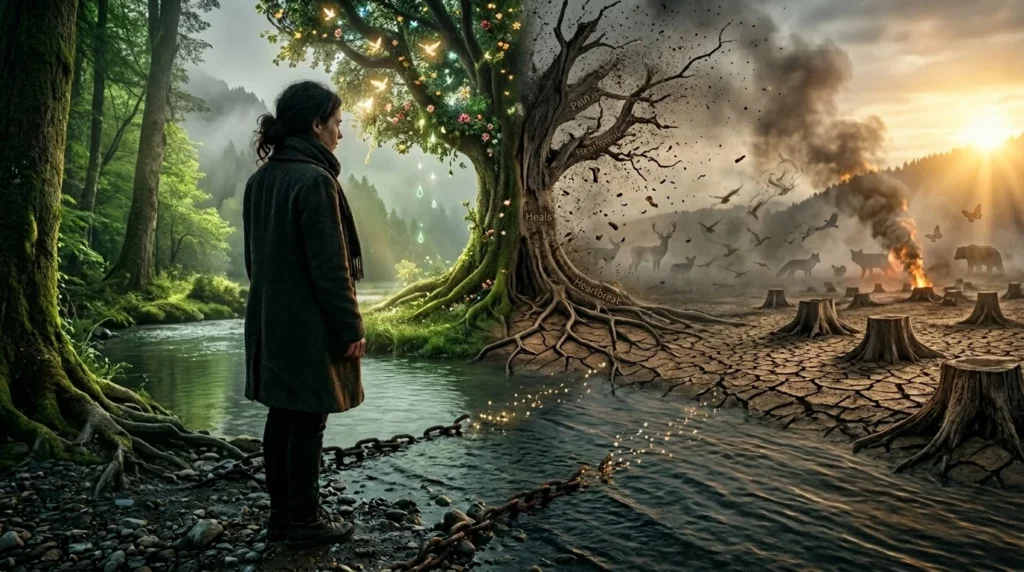
When students try to describe deforestation, they often pause at the same problem. How do you explain something so large, so silent, and yet so destructive? Cutting down trees is easy to say—but it doesn’t carry emotion. That’s where a metaphor for deforestation becomes powerful.
Instead of saying “trees are being cut,” writers say things like “the forest is bleeding green” or “the earth is losing its hair.” Suddenly, the idea feels alive, painful, and real.
People search for this topic because they want words that feel like nature is disappearing, not just describe it. They want writing that helps readers see the loss, almost like a wound opening in the planet itself.
Here’s the simple truth: metaphors turn environmental damage into human emotion. And that emotional shift is what makes writing unforgettable.
Let’s explore how writers build these images step by step.
What Is a Metaphor for Deforestation?
A metaphor for deforestation is a figurative comparison that describes forest loss as something else—usually something human, emotional, or physical—to help readers feel its impact.
Simple definition (featured snippet style):
A metaphor for deforestation is a way of describing forest destruction using symbolic language instead of literal facts.
Writers use metaphors because facts alone feel distant. But imagery brings emotion closer.
For example:
- “The forest is a green heart being cut open.”
- “Earth is shedding its skin of trees.”
- “The jungle is a forgotten cathedral collapsing in silence.”
Think about it this way:
Metaphors turn science into storytelling.
That tiny change creates a stronger image in the reader’s mind.
Quick List of Metaphor for Deforestation Examples
Here are simple, emotional, and creative metaphors you can copy or adapt:
- “The forest is a fading green blanket.” — loss of tree cover
- “Earth is going bald.” — trees being removed
- “Nature is losing its lungs.” — environmental harm
- “The jungle is a broken crown.” — lost natural beauty
- “Trees are green soldiers falling in silence.” — mass cutting
- “The forest is a dying library of life.” — biodiversity loss
- “Deforestation is Earth’s skin being peeled away.” — exposed land
- “The woods are a vanishing dream.” — disappearing ecosystems
- “Forests are green oceans drying up.” — large-scale loss
- “Nature is being erased like pencil marks.” — human impact
- “The rainforest is a heartbeat slowing down.” — ecological damage
- “Trees are Earth’s hair being shaved away.” — visible destruction
- “The forest is a cathedral losing its pillars.” — structural collapse
- “Deforestation is a slow green funeral.” — ongoing loss
- “The land is forgetting how to breathe.” — environmental suffocation
- “Forests are pages torn from Earth’s book.” — loss of history
- “Nature is a painting being wiped away.” — visual destruction
- “The jungle is a sleeping giant being cut apart.” — powerful ecosystem
- “Trees are guardians falling from their posts.” — protection lost
- “The forest is a green memory fading out.” — disappearance over time
Beautiful Metaphors for Deforestation
Some metaphors feel more emotional because they connect nature to the human body or life.
Here are deeper ones:
- “The forest is Earth’s lungs being unplugged.”
- “Deforestation is a slow pulse fading under bark.”
- “Trees are veins of green life being severed.”
- “The rainforest is a broken mirror of life.”
- “Nature is a mother losing her children one by one.”
Here’s the simple trick:
When you connect nature to body parts or emotions, the reader feels responsibility.
That’s what makes these metaphors powerful in essays and poetry.
Poetic and Deep Metaphor for Deforestation Ideas
Now let’s go more artistic.
- “The forest is a cathedral where prayers have stopped.”
- “Green silence is falling where birds once wrote songs in the air.”
- “The earth is learning grief in shades of brown.”
- “Deforestation is a poem being erased mid-line.”
- “The jungle is a dream being cut before morning arrives.”
Most writers use this style because it turns environmental loss into poetry, not just explanation.
That emotional layer is what readers remember.
Metaphor for Deforestation in Creative Writing
Writers use metaphors for deforestation in:
- essays about climate change
- environmental poetry
- storytelling
- school assignments
- speeches and debates
Example in writing:
“The forest stood like an old guardian, but each falling tree stole another piece of its memory.”
Another example:
“Machines moved through the jungle like silence with teeth.”
That second sentence shows action without directly explaining it.
That’s the magic of figurative language.
Metaphor vs Simile
| Feature | Metaphor | Simile |
|---|---|---|
| Meaning | Direct comparison | Uses “like” or “as” |
| Example | “The forest is a dying lung” | “The forest is like a dying lung” |
| Impact | Stronger emotion | Softer imagery |
| Grammar | No connecting words | Uses comparison words |
| Beginner mistake | Too abstract sometimes | Overusing “like” or “as” |
Why People Confuse Metaphors and Similes
This is where many beginners get confused.
- Both compare two things
- Both create imagery
- School books often mix examples
- Students copy patterns without understanding meaning
Simple rule:
If it is something → metaphor
If it is like something → simile
That’s it.
Real-Life Conversation Examples
1. Classroom discussion
Student: “Sir, how do I describe deforestation emotionally?”
Teacher: “Say the forest is a green heart being cut.”
🎯 Lesson: Emotion matters more than facts.
2. Poetry writing group
Writer: “I wrote: the jungle is crying wood.”
Friend: “That feels powerful.”
🎯 Lesson: Short metaphors can be strong.
3. Social media caption
User: “Nature is a library burning page by page.”
Follower: “That hits hard.”
🎯 Lesson: Metaphors work in captions too.
4. School essay help
Student: “Can I say trees are Earth’s lungs?”
Teacher: “Yes, that’s perfect.”
🎯 Lesson: Simple metaphors are often best.
How to Create Your Own Metaphor for Deforestation
Here’s the simple creative trick:
- Think of forests as something alive
- Choose a human body part (lungs, heart, skin)
- Or choose something emotional (memory, dream, home)
- Connect destruction to pain or loss
Try this formula:
Forest = something living + damage = emotional result
Examples you can build:
- Forest + lungs → “lungs of the earth”
- Trees + hair → “earth going bald”
- Jungle + memory → “fading memory of green”
That tiny shift creates powerful writing.
Common Mistakes Beginners Make
- Using overly complex words — makes meaning unclear
- Mixing metaphor and simile incorrectly — weakens imagery
- Making metaphors too long — loses impact
- Using clichés too often — feels boring
- Forgetting emotion — turns writing mechanical
Correct version example:
❌ “The forest is like a very big place of trees disappearing slowly.”
✔ “The forest is a fading green memory.”
Related Figurative Language Terms
- Simile: Comparison using “like” or “as”
- Imagery: Language that creates mental pictures
- Personification: Giving human traits to nature
- Symbolism: Using objects to represent ideas
- Hyperbole: Extreme exaggeration for effect
These tools often work together in environmental writing.
Frequently Asked Questions
What is a simple metaphor for deforestation?
“The forest is Earth’s lungs being removed.”
Why do writers use metaphors for deforestation?
To make environmental loss emotional and easier to visualize.
What is a poetic metaphor for forests disappearing?
“The jungle is a fading green dream.”
Can I use metaphors in school essays?
Yes, they improve creativity and clarity.
What is a powerful metaphor for trees being cut down?
“Trees are green soldiers falling in silence.”
Are metaphors better than facts?
Both matter—metaphors make facts emotionally meaningful.
Symbolism in Nature Writing
In literature, forests often symbolize life, balance, and memory. When deforestation appears in writing, it usually represents broken harmony between humans and nature.
Writers like to show forests not just as land, but as living identity. When trees disappear, it feels like something sacred is being lost.
That’s why metaphors for deforestation often feel spiritual, emotional, or even mournful.
Conclusion
A strong metaphor for deforestation doesn’t just describe trees being cut—it makes the reader feel the loss. It turns silent destruction into emotional imagery, where forests become lungs, hearts, memories, or dreams slowly fading away.
When you use metaphors in your writing, you are not just decorating sentences—you are giving nature a voice. And that voice can stay in a reader’s mind long after the words end.
So next time you write about forests, don’t just explain them. Let them breathe, speak, and even cry through your words.