
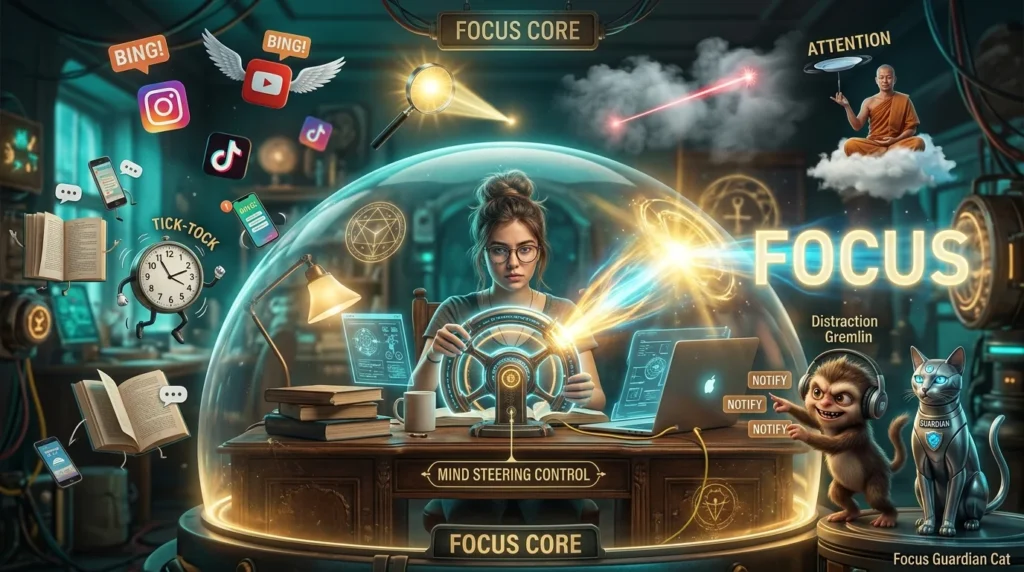
Have you ever sat down to write and felt your thoughts scattering like birds in the sky? Many students and writers search for a metaphor for concentration when they struggle to describe what focus actually feels like in words. It’s not just about saying “I was focused.” That feels flat. Writers want something deeper, something that shows attention locking in like a beam of light or a quiet storm inside the mind.
This is where figurative language becomes powerful. Through metaphor, imagery, and emotional writing, we can turn invisible mental effort into something vivid and alive. But beginners often get confused—how do you describe something as abstract as concentration?
Think about it this way: concentration is not seen, it is felt. So writers borrow images from nature, machines, fire, and silence to explain it. In this guide, you’ll learn simple and beautiful ways to express focus like a real writer. Let’s open that door together.
What Is a Metaphor for Concentration?
A metaphor for concentration is a figure of speech that describes focus by comparing it to something else without using “like” or “as.” It helps readers see how concentration feels in a creative way.
In simple words:
It turns focus into an image you can imagine.
Writers use this because concentration is abstract. You cannot touch it or see it directly, so you describe it using symbolism, imagery, and everyday objects.
For example:
- “Her mind was a locked room.”
- “His focus was a laser cutting through noise.”
These lines use figurative language to make thinking feel real and visual. This is a key tool in creative writing and poetry.
Quick List of Metaphors for Concentration Examples
Here are easy, copy-ready examples of focus expressed through metaphor, imagery, and emotion:
- My mind was a locked door 🔒 (no distraction enters)
- Her focus was a burning candle in a dark room (steady attention)
- His thoughts were a laser beam (sharp and direct focus)
- Concentration was a calm lake (still and undisturbed mind)
- My brain became a tunnel (only one direction matters)
- Focus was a magnet pulling every thought inward
- Her attention was a spotlight on one stage
- His mind was a quiet library (silent and ordered thinking)
- Concentration felt like a tight rope (careful balance)
- My thoughts turned into a single flowing river
- Focus was a storm frozen in place
- Her brain became a chessboard (strategic thinking)
- Concentration was a locked vault of silence
- His attention was a sword cutting distractions
- My focus was a glowing ember (small but powerful)
- Her mind was a camera lens zooming in
- Concentration felt like deep space—silent and infinite
- His thoughts were arrows hitting one target
- Focus was a mountain standing still in wind
- My brain became a sealed container of ideas
Beautiful Metaphors for Concentration
Some metaphors feel soft and emotional, almost poetic:
- “Her focus was moonlight on still water.”
- “His concentration was a quiet snowfall covering noise.”
- “My mind became a lantern in the fog.”
- “Focus was a thread weaving every thought together.”
- “Her attention was a gentle flame refusing to die.”
These examples use emotional imagery to show calm, steady mental energy. They feel peaceful and human.
Poetic and Deep Concentration Ideas
Writers often use deeper symbolism to express intense focus:
- “His mind was a fortress where silence ruled.”
- “Concentration was a black hole pulling every thought inward.”
- “Her focus was a cathedral of stillness.”
- “My thoughts became ink settling into one line.”
- “Focus was a winter night where nothing moved but thinking.”
This style often appears in poetry and literary devices where meaning is layered and symbolic.
Concentration in Creative Writing
In creative writing, concentration helps show a character’s mental state without saying it directly. Instead of “he was focused,” you show it:
Example:
“The classroom faded away. Only the math problem stayed, floating like a star in his mind.”
Writers use imagery, symbolism, and personification to build this effect.
Uses include:
- storytelling (showing deep thinking moments)
- poetry (expressing inner calm or intensity)
- essays (making descriptions stronger)
- school writing (improving marks with vivid language)
Metaphor vs Simile
| Feature | Metaphor | Simile |
|---|---|---|
| Meaning | Direct comparison | Comparison using “like/as” |
| Example | My mind is a tunnel | My mind is like a tunnel |
| Emotional Impact | Stronger, deeper | Softer, clearer |
| Usage | Poetry, storytelling | Beginner writing |
| Mistake | Too abstract sometimes | Can feel weaker in imagery |
Both are figurative language tools, but metaphor feels more powerful and direct.
Why People Confuse Metaphors and Similes
This is where many beginners struggle.
- School lessons mix both together
- Sentence patterns look similar
- Students forget the “like/as” rule
- Both describe imagination-based comparisons
Simple trick:
If you see “like” or “as,” it’s a simile. If not, it’s a metaphor.
Real-Life Conversation Examples
1. Classroom Discussion
Teacher: “Describe concentration in a creative way.”
Student: “My focus was a flashlight in a dark room.”
🎯 Lesson: Metaphors make writing vivid.
2. Study Session
Friend: “How did you stay so focused?”
You: “My brain was a locked tunnel.”
🎯 Lesson: Focus can be shown visually.
3. Social Media Caption
“Today my mind was a calm ocean—nothing could disturb it.”
🎯 Lesson: Metaphors work great in captions.
4. Poetry Practice
Writer: “My attention became a single burning star.”
🎯 Lesson: Imagery creates emotion.
How to Create Your Own Metaphor for Concentration
Here’s a simple method:
- Think of focus as stillness or direction
- Choose an object (river, light, sword, tunnel)
- Ask: “What feels similar?”
- Connect emotion to image
Example:
Focus → calm → lake → “My mind was a still lake.”
That tiny connection creates strong poetic expression.
Common Mistakes Beginners Make
- Using too many ideas in one metaphor (confusing meaning)
- Choosing random objects with no emotional link
- Writing overly complex sentences
- Mixing simile and metaphor incorrectly
- Forcing creativity instead of feeling it naturally
Correct version is always simple and clear.
Related Figurative Language Terms
- Linguistics: The science of language structure and meaning
- Simile: Direct comparison using “like/as”
- Imagery: Words that help readers visualize scenes
- Personification: Making non-human things act human
- Symbolism: Deeper meaning behind simple things
- Hyperbole: Emotional exaggeration in writing
Frequently Asked Questions
1. What is a simple metaphor for concentration?
A simple one is: “My mind was a locked door.”
2. Why are metaphors used for focus?
They help turn abstract thoughts into visual images.
3. Can students use metaphors in essays?
Yes, they improve creativity and writing scores.
4. What is the difference between focus and concentration metaphor?
They are often used the same way in writing.
5. What is a poetic metaphor for concentration?
“My focus was moonlight on still water.”
6. Are metaphors better than similes?
Metaphors feel stronger and more emotional, but both are useful.
7. How do I write my own metaphor?
Connect emotion with a physical object or image.
OPTIONAL AUTHORITY INSIGHT
In literature, concentration is often symbolized through silence, light, or isolation. Poets use these images because focus is an inner experience, not a visible action. That’s why metaphors like “light in darkness” or “still water” appear in many classic writings—they reflect clarity of mind and emotional control.
CONCLUSION
Learning how to create a metaphor for concentration helps you turn invisible thoughts into powerful writing. Instead of saying “I was focused,” you now have tools to show it through images like light, silence, rivers, or fire.
The more you practice figurative language, the more natural your writing becomes. Concentration is not just a mental state—it can become a story, a picture, or even a poem in your hands. Keep experimenting, keep imagining, and your writing will slowly feel more alive and expressive.