
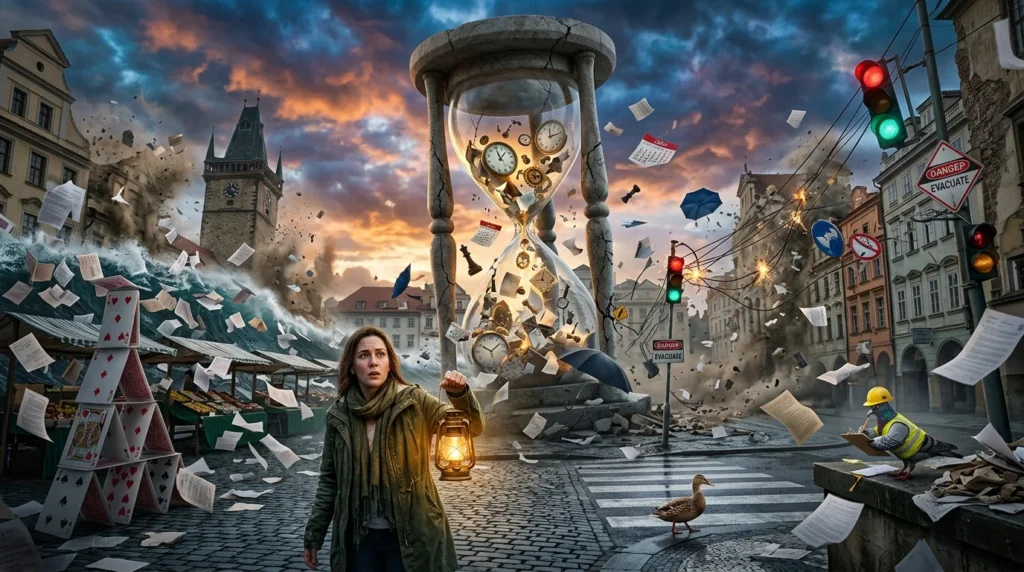
A storm tears through a quiet town. A relationship suddenly falls apart. One phone call changes everything in a single second. In moments like these, ordinary words often feel too small. That’s why writers search for a metaphor for calamity — to turn pain, chaos, fear, and destruction into vivid emotional imagery people can actually feel.
Maybe you are writing poetry. Maybe you need stronger descriptions for a story or school assignment. Or maybe you simply want language that captures emotional disaster in a more beautiful and meaningful way.
This is where metaphors become powerful.
A good metaphor does more than describe tragedy. It paints pictures in the reader’s mind. It transforms fear into storms, heartbreak into collapsing buildings, and emotional ruin into burning forests. That tiny change creates a stronger image.
In this guide, you’ll discover poetic metaphor ideas, beginner-friendly explanations, emotional examples, symbolism, creative writing tips, and real-life usage examples that make calamity feel unforgettable.
What Is a Metaphor for Calamity?
A metaphor for calamity compares disaster or chaos to something symbolic without using “like” or “as.”
Think about it this way:
Instead of saying:
- “Her life became difficult.”
A writer might say:
- “Her world cracked open.”
That sentence creates emotional imagery instantly.
Writers use metaphors for calamity because they:
- make emotions stronger
- create dramatic imagery
- add poetic beauty
- help readers feel tension
- turn abstract pain into visual language
Simple Examples
- “The city became a graveyard of smoke.”
- “His anger was a wildfire.”
- “The news hit like a collapsing sky.”
- “Their marriage was a sinking ship.”
These metaphors turn emotional disaster into something visual and memorable.
Quick List of Metaphor for Calamity Examples
Here are easy copy-and-paste examples with short meanings beside them.
- A collapsing bridge — broken trust or failure
- A wildfire — fast-moving destruction
- A black tide — overwhelming disaster
- A cracked mirror — shattered identity
- A sinking ship — hopeless situation
- A thunderstorm inside the heart — emotional chaos
- A falling kingdom — total collapse
- An earthquake of grief — deep emotional shock
- A poisoned river — spreading damage
- A dying star — fading hope
- A broken compass — loss of direction
- A house of ashes — ruined dreams
- A silent avalanche — hidden disaster approaching
- A bleeding sky — sorrow or violence
- A tornado of fear — panic and confusion
- A shattered crown — loss of power
- A frozen battlefield — emotional emptiness after conflict
- A drowning forest — nature overwhelmed
- A rusted chain reaction — unstoppable problems
- A dark eclipse — loss of joy or clarity
- A storm without shelter — helplessness
- A volcano beneath the skin — bottled emotions exploding
- A cracked dam — emotions losing control
- A graveyard of memories — painful past
- A rotten foundation — hidden problems causing collapse
Beautiful Metaphors for Calamity
Some metaphors feel tragic but strangely beautiful at the same time. Most writers use this because emotional imagery becomes more memorable when it sounds poetic.
The Ocean Swallowed the Shore
This metaphor suggests disaster slowly consuming safety, peace, or stability.
Example:
“After the betrayal, it felt as if the ocean had swallowed the shore beneath her feet.”
A Sky Full of Broken Glass
This creates a sharp, painful visual image.
Example:
“The argument shattered above them like a sky full of broken glass.”
A Candle Drowning in Rain
Perfect for emotional exhaustion or fading hope.
Example:
“His courage was a candle drowning in rain.”
The Forest Turned to Smoke
A nature-inspired metaphor for destruction and loss.
Example:
“Their childhood home became a forest turned to smoke.”
A Kingdom Built on Sand
This metaphor symbolizes weak foundations and inevitable collapse.
Example:
“Their success was a kingdom built on sand.”
Poetic and Deep Metaphor for Calamity Ideas
These examples lean into symbolism and literary-style imagery.
The Moon Wore Mourning Clothes
This metaphor creates sadness and darkness without directly mentioning tragedy.
Example:
“The moon wore mourning clothes the night the village burned.”
Time Became a Ruined Cathedral
This symbolizes emotional emptiness after disaster.
Example:
“After the accident, time became a ruined cathedral echoing with silence.”
Her Heart Was a Battlefield After Winter
Coldness and destruction combine here to show emotional damage.
Example:
“Her heart was a battlefield after winter — frozen, silent, and abandoned.”
The River Forgot Its Song
This metaphor symbolizes lost peace or innocence.
Example:
“After the war, the river forgot its song.”
Darkness Ate the Horizon
A powerful fantasy-style image for approaching disaster.
Example:
“Darkness ate the horizon as fear spread through the kingdom.”
Metaphor for Calamity in Creative Writing
This is where many beginners get confused.
A metaphor should not just sound dramatic. It should match the emotion of the scene.
In Stories
Writers use calamity metaphors to build tension and emotion.
Example
Plain sentence:
- “The town was destroyed.”
Creative version:
- “The town lay beneath the ashes like a forgotten memory.”
That tiny change creates a stronger image.
In Poetry
Poetry often uses symbolic imagery instead of direct explanation.
Example
- “Grief knocked down every door inside me.”
This line feels emotional because readers imagine destruction happening physically.
In School Assignments
Teachers love metaphors because they show imagination and descriptive writing skills.
Example
Instead of:
- “The test was hard.”
Try:
- “The exam was a mountain collapsing beneath my feet.”
In Social Media Captions
Short metaphors create emotional impact quickly.
Examples:
- “Some storms never touch the sky.”
- “Chaos moved in quietly.”
- “Even ashes remember fire.”
Metaphor vs Simile
| Feature | Metaphor | Simile |
|---|---|---|
| Meaning | Direct comparison | Comparison using “like” or “as” |
| Grammar | Says something is something else | Says something is like something |
| Emotional Impact | Stronger and more dramatic | Softer and more descriptive |
| Example | “Life is a storm.” | “Life is like a storm.” |
| Beginner Mistake | Forgetting symbolism | Overusing “like” repeatedly |
Why People Confuse Metaphors and Similes
Both are forms of figurative language, so they sound similar at first.
But here’s the simple trick:
- A simile compares using “like” or “as.”
- A metaphor replaces one thing with another image completely.
Easy Example
Simile:
- “Fear spread like wildfire.”
Metaphor:
- “Fear was a wildfire.”
The metaphor feels stronger because it sounds more direct and emotional.
Many beginners accidentally mix the two because schools often teach them together.
Real-Life Conversation Examples
1. Classroom Discussion
Student: “I don’t know how to describe the disaster scene.”
Teacher: “Think visually. Was it a storm, an avalanche, or a collapsing tower?”
Student: “Oh — the city became a sinking ship.”
🎯 Lesson: Metaphors create pictures readers can imagine.
2. Poetry Writing
Friend: “Your poem sounds flat.”
Writer: “Maybe I explained too much.”
Friend: “Try imagery instead.”
Writer: “Then grief became a black ocean.”
🎯 Lesson: Emotional imagery feels stronger than direct explanation.
3. Social Media Caption
Person 1: “What caption are you using?”
Person 2: “Probably ‘My thoughts became thunderstorms.’”
🎯 Lesson: Short metaphors can carry huge emotional weight.
4. Storytelling Scene
Editor: “The danger doesn’t feel intense yet.”
Writer: “What if I describe the kingdom as a house of falling cards?”
🎯 Lesson: Metaphors increase tension instantly.
How to Create Your Own Metaphor for Calamity
You do not need to be a professional poet.
Most strong metaphors come from simple emotional connections.
1. Think About the Emotion
Ask yourself:
- Does the calamity feel violent?
- silent?
- overwhelming?
- slow?
- explosive?
The emotion guides the imagery.
2. Match It to Something Visual
Examples:
| Emotion | Visual Image |
|---|---|
| Panic | Tornado |
| Sadness | Drowning ocean |
| Collapse | Falling tower |
| Fear | Dark forest |
| Anger | Wildfire |
3. Use Symbolism
Symbolism makes metaphors deeper.
Examples:
- rain = sadness
- fire = destruction or rage
- winter = emotional coldness
- shadows = fear
- oceans = overwhelming emotions
4. Keep It Simple
Beginners often overcomplicate metaphors.
Simple:
- “Hope became smoke.”
Too complicated:
- “Hope transformed into an atmospheric vaporized representation of despair.”
Simple imagery feels more human.
Common Mistakes Beginners Make
Using Mixed Metaphors
❌ “The wildfire drowned the ship.”
✔ “The wildfire consumed the forest.”
Why it happens:
People combine unrelated images accidentally.
Over-Explaining the Meaning
❌ “His heart was a volcano because he was angry.”
✔ “His heart was a volcano.”
Readers understand the emotion already.
Making Metaphors Too Random
❌ “Sadness was a toaster.”
✔ “Sadness was a cold empty room.”
The image should connect emotionally.
Using Clichés Too Often
❌ “Life is a roller coaster.”
✔ “Life became a bridge cracking beneath us.”
Fresh imagery feels more memorable.
Related Figurative Language Terms
Simile
A comparison using “like” or “as.”
Example:
- “Fear spread like smoke.”
Imagery
Language that creates mental pictures.
Example:
- “Ash floated through the empty streets.”
Personification
Giving human traits to non-human things.
Example:
- “The storm screamed through the valley.”
Symbolism
Using objects or images to represent ideas.
Example:
- ravens = death
- winter = loneliness
- fire = destruction
Hyperbole
Extreme exaggeration for emotional effect.
Example:
- “The grief shattered the universe.”
Symbolism of Calamity in Literature
Throughout literature, calamity often symbolizes transformation.
A storm may represent emotional conflict.
A collapsing city may symbolize moral decay.
A flood can symbolize rebirth after destruction.
Many famous writers use nature symbolism because readers connect emotionally to visual disasters.
In gothic fiction, calamity often appears as darkness, storms, ravens, ruins, or dying landscapes.
In fantasy stories, kingdoms collapsing usually symbolize pride, corruption, or lost hope.
That’s why calamity metaphors feel timeless. They mirror real human fear and change.
Frequently Asked Questions
What is a metaphor for calamity?
A metaphor for calamity is a symbolic comparison that describes disaster, chaos, or emotional destruction in a vivid way.
What is an example of a calamity metaphor?
“Her life became a burning house” is a metaphor for calamity.
Why do writers use calamity metaphors?
Writers use them to create emotional imagery, dramatic tension, and stronger storytelling.
Is “life is like a storm” a metaphor?
No. That is a simile because it uses “like.”
What makes a strong metaphor?
Strong metaphors create clear emotional and visual imagery that readers instantly understand.
Can metaphors be dark and poetic?
Yes. Many poetic metaphors use darkness, storms, ruins, fire, and shadows to express emotion.
Are metaphors useful in school writing?
Absolutely. They improve descriptive writing, storytelling, poetry, and literary analysis.
How can beginners practice metaphors?
Start by matching emotions to visual images like storms, oceans, forests, or fire.
Conclusion
Learning how to use a metaphor for calamity can completely change your writing. Instead of simply describing disaster, you create emotion readers can actually see and feel.
That’s the magic of figurative language.
A wildfire becomes anger. A collapsing bridge becomes broken trust. A storm becomes grief. Suddenly, ordinary sentences carry emotional weight and poetic beauty.
The best part is that you do not need fancy vocabulary to write powerful metaphors. Simple images often create the strongest impact.
So the next time you write a poem, story, caption, or school assignment, pause for a moment and ask yourself:
“What does this emotion look like?”
That single question is where unforgettable imagery begins.