
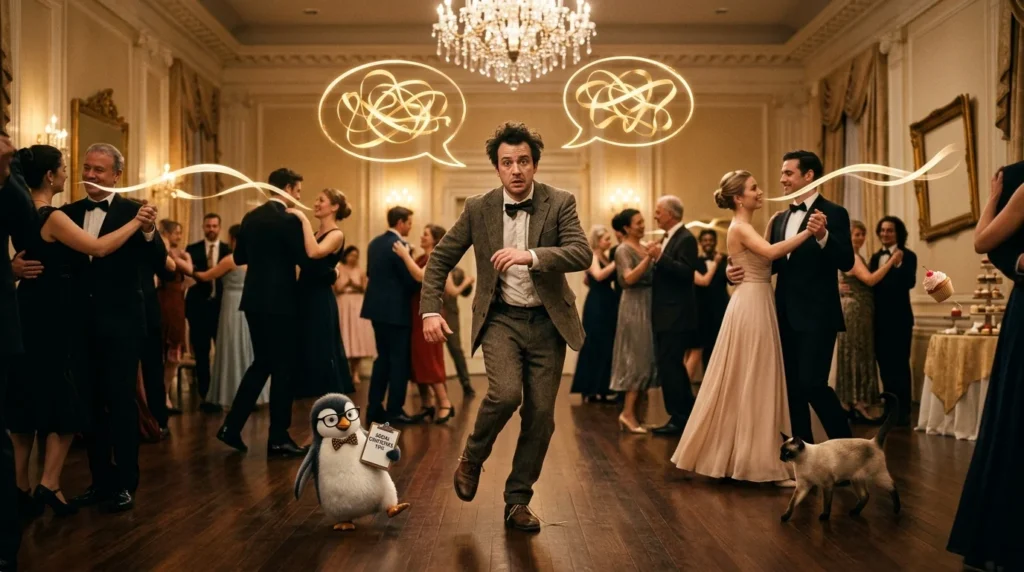
Have you ever tried to describe a painfully uncomfortable moment and felt like the word awkward just wasn’t enough?
Maybe you walked into the wrong classroom. Maybe you waved back at someone who wasn’t waving at you. Or perhaps you sat in complete silence after making a joke that nobody understood.
These moments create feelings that are hard to explain with ordinary words. That’s why many writers search for a metaphor for awkward situations. A good metaphor turns an uncomfortable feeling into a vivid image people can instantly understand.
Whether you’re writing a story, poem, school assignment, social media caption, or personal journal, metaphors can make awkward moments feel more relatable, emotional, and memorable.
Let’s explore some creative ways to describe awkwardness through imagery, symbolism, and figurative language.
What Is a Metaphor for Awkward?
A metaphor for awkward is a figurative comparison that describes uncomfortable, clumsy, or socially uneasy situations by comparing them to something else without using “like” or “as.”
In simple terms, a metaphor paints a picture of awkwardness.
Instead of saying:
“The conversation was awkward.”
You might say:
“The conversation was a car stuck in mud.”
That image instantly helps readers feel the struggle.
Writers use metaphors because they:
- Create stronger imagery
- Add emotion to writing
- Make scenes memorable
- Help readers relate to feelings
- Improve storytelling and poetry
Awkwardness is often connected to embarrassment, uncertainty, tension, silence, and social discomfort. Metaphors bring those feelings to life.
Quick List of Metaphor for Awkward Examples
Here are some easy copy-and-paste examples:
- A penguin in the desert — completely out of place
- A square peg in a round hole — doesn’t fit
- A car stalled at a green light — stuck unexpectedly
- A balloon losing air — confidence fading
- A record skipping — conversation interruption
- A knot in a shoelace — tangled situation
- A fish on a bicycle — something that doesn’t belong
- A broken compass — unsure where to go
- A door that won’t open — social resistance
- A frozen computer screen — inability to respond
- A giraffe in a phone booth — uncomfortable fit
- A dance with two left feet — social clumsiness
- A spotlight with nowhere to hide — unwanted attention
- A puzzle piece from another box — feeling different
- A hiccup in a speech — sudden discomfort
- An umbrella in a hurricane — unprepared
- A bird with wet wings — struggling to move forward
- A squeaky wheel in a quiet room — standing out unintentionally
- A missed step on a staircase — unexpected embarrassment
- A tangled necklace chain — social confusion
- A chair with one short leg — unstable interaction
- A traffic jam in the mind — mental hesitation
- A cracked mirror — self-consciousness
- A lone cloud at a picnic — disrupting the mood
- A violin out of tune — social mismatch
- A glitch in reality — strange discomfort
- A puppet with tangled strings — awkward movement
- A sentence missing a word — incomplete communication
- A candle flickering in the wind — fragile confidence
- A deer under bright headlights — frozen uncertainty
- An actor forgetting the script — social panic
- A zipper stuck halfway — uncomfortable pause
- A snowman in summer — out of place
- A wheel spinning in sand — effort without progress
- A bridge that doesn’t reach the other side — failed connection
Beautiful Metaphors for Awkward
These metaphors create stronger emotional imagery.
A Deer Beneath Headlights
Awkwardness often makes people freeze.
Example:
“When everyone looked at him, he became a deer beneath headlights.”
The image captures fear, surprise, and uncertainty.
A Song Missing Its Rhythm
Some conversations lose their natural flow.
Example:
“Their first date was a song missing its rhythm.”
This metaphor feels gentle and relatable.
A Flower Blooming in Winter
Someone may feel completely out of place.
Example:
“She stood among strangers, a flower blooming in winter.”
A Boat Drifting Without Oars
Awkward interactions often lack direction.
Example:
“The conversation drifted like a boat without oars.”
Poetic and Deep Awkward Ideas
Writers often use symbolism to show awkward feelings indirectly.
A Shadow Looking for Its Owner
Meaning:
Feeling disconnected or uncertain.
A Clock Missing Its Hands
Meaning:
Not knowing what to do next.
A Bird Singing in an Empty Forest
Meaning:
Speaking without receiving a response.
A Bridge Suspended in Fog
Meaning:
Trying to connect but lacking clarity.
A Star Lost Before Dawn
Meaning:
Feeling unnoticed and misplaced.
A Candle Unsure of the Wind
Meaning:
Fragile confidence during social situations.
A River Trapped by Ice
Meaning:
Emotions that cannot flow naturally.
Awkward in Creative Writing
Awkwardness creates realism.
Most people experience it, so readers instantly recognize it.
Storytelling Example
Instead of:
“Tom felt awkward at the party.”
Write:
“Tom was a lone puzzle piece dropped into the wrong box.”
Poetry Example
“My words were birds with broken wings,
circling a sky that would not open.”
Descriptive Writing Example
“Silence settled between them, a heavy coat neither wanted to wear.”
School Assignment Example
“Standing in front of the class felt like balancing on a tightrope over a room full of eyes.”
That tiny change creates a stronger image.
Metaphor vs Simile
| Feature | Metaphor | Simile |
|---|---|---|
| Meaning | Direct comparison | Comparison using like or as |
| Grammar | Says something is something else | Says something is like something else |
| Emotional Impact | Stronger and more vivid | Softer and more explicit |
| Example | The meeting was a train wreck. | The meeting was like a train wreck. |
| Example | She was a deer beneath headlights. | She was like a deer beneath headlights. |
| Common Mistake | Taking metaphor literally | Overusing like and as |
Why People Confuse Metaphors and Similes
This is where many beginners get confused.
Both metaphors and similes compare two things.
The difference is simple:
Metaphor
“The classroom was a battlefield.”
Simile
“The classroom was like a battlefield.”
Many students focus on the image and forget the grammar.
Remember:
- Metaphor = direct comparison
- Simile = comparison using “like” or “as”
That’s the easiest way to tell them apart.
Real-Life Conversation Examples
School
Student:
“Presenting my project felt like standing under a giant spotlight.”
Friend:
“Yeah, the whole room becomes a stage.”
🎯 Lesson: Metaphors make feelings easier to understand.
Classroom
Teacher:
“Why didn’t you answer?”
Student:
“My brain was a traffic jam.”
🎯 Lesson: Metaphors explain hesitation vividly.
Poetry Writing
Writer:
“How do I describe awkward silence?”
Friend:
“Call it a bridge covered in fog.”
🎯 Lesson: Symbolic imagery creates emotion.
Social Media Caption
Caption:
“Third-wheeling again. Just a chair with one short leg at the table.”
🎯 Lesson: Metaphors add personality.
Storytelling
Character:
“After my mistake, I became a snowman in summer.”
🎯 Lesson: Being out of place is a common awkward theme.
How to Create Your Own Metaphor for Awkward
Here’s the simple trick.
Think about the feeling first.
Ask yourself:
- Does awkwardness feel stuck?
- Does it feel misplaced?
- Does it feel frozen?
- Does it feel exposed?
Then find an object or image with that same feeling.
Method 1: Visualize the Emotion
Awkward = stuck
Possible metaphor:
“A wheel trapped in sand.”
Method 2: Use Nature
Awkward = out of place
Possible metaphor:
“A sunflower blooming in darkness.”
Method 3: Use Symbolism
Awkward = uncertainty
Possible metaphor:
“A compass spinning without direction.”
Method 4: Think About Movement
Awkward = clumsy
Possible metaphor:
“A puppet tangled in its own strings.”
Most writers use this because readers instantly understand the image.
Common Mistakes Beginners Make
Using clichés too often
Why it happens: They’re familiar.
Better version: Create a fresh image.
Mixing multiple metaphors
Why it happens: Too many ideas at once.
Better version: Stick with one image.
Choosing unrelated comparisons
Why it happens: Focusing on creativity instead of meaning.
Better version: Match the image to the emotion.
Explaining the metaphor too much
Why it happens: Fear readers won’t understand.
Better version: Let the image do the work.
Using weak imagery
Why it happens: Picking ordinary objects.
Better version: Choose visual and emotional symbols.
Related Figurative Language Terms
Simile
A comparison using “like” or “as.”
Example:
“She looked like a deer in headlights.”
Imagery
Language that creates pictures in the reader’s mind.
Personification
Giving human qualities to nonhuman things.
Example:
“The silence stared back.”
Symbolism
Using objects or images to represent ideas.
Example:
A broken bridge may symbolize failed connection.
Hyperbole
Intentional exaggeration.
Example:
“The awkward silence lasted a thousand years.”
Symbolism of Awkwardness in Literature
Many authors use awkward moments to reveal character growth.
An awkward scene often symbolizes:
- Insecurity
- Change
- Self-discovery
- Social pressure
- Personal growth
Interestingly, some of the most memorable literary characters experience awkwardness because it makes them feel human.
Readers connect with imperfection.
That’s why awkwardness appears so often in novels, poetry, and coming-of-age stories.
Frequently Asked Questions
What is the best metaphor for awkward?
A popular metaphor is “a deer beneath headlights” because it captures surprise, fear, and uncertainty.
What is a poetic metaphor for awkwardness?
“A river trapped beneath ice” is a poetic metaphor that suggests emotions struggling to flow.
What metaphor means feeling out of place?
“A penguin in the desert” is a strong metaphor for feeling out of place.
Can awkwardness be used in poetry?
Yes. Poets often use awkwardness to explore vulnerability, embarrassment, and human connection.
What is the difference between awkward and embarrassed?
Awkward describes discomfort in a situation, while embarrassed usually involves shame or self-consciousness.
Is awkwardness a good topic for creative writing?
Absolutely. Awkward moments create realism, character development, and emotional depth.
How do I make my own awkward metaphor?
Find the feeling first, then compare it to an object, scene, or symbol that creates the same emotional effect.
Why do writers use metaphors for awkwardness?
Metaphors help readers feel the emotion instead of simply being told about it.
Conclusion
Awkward moments may feel uncomfortable in real life, but they can become powerful tools in writing. A strong metaphor for awkward transforms an ordinary feeling into something readers can see, feel, and remember.
Whether you choose a deer beneath headlights, a bridge lost in fog, or a puzzle piece from another box, the goal is the same: create an image that captures the emotion behind the moment.
The more you practice, the easier it becomes to turn everyday experiences into vivid figurative language. So the next time you find yourself searching for the perfect way to describe an awkward situation, trust your imagination.
Sometimes the most memorable writing begins with the moments we’d rather forget. ✨