
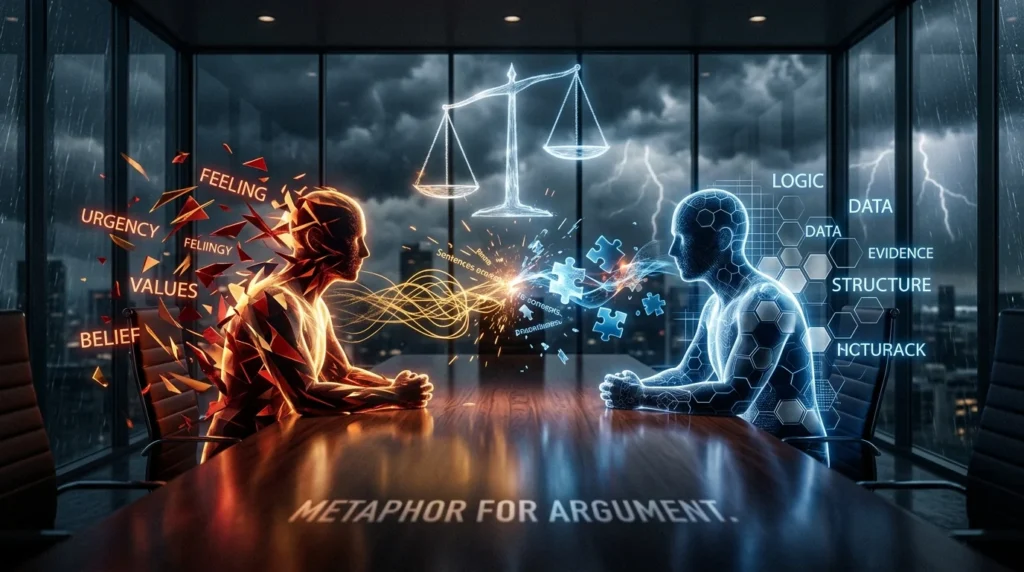
Arguments are part of everyday life.
They happen between friends, families, classmates, couples, and even inside our own minds.
But when writers describe an argument in plain words, the scene can feel flat.
That’s why so many people search for a metaphor for argument. A good metaphor turns a simple disagreement into something readers can see, feel, and remember. Instead of saying “they argued loudly,” a writer might say, “their words became daggers in the dark.”
That tiny change creates a stronger image.
Metaphors help writers add emotion, tension, symbolism, and poetic language to their work. They also make essays, stories, songs, captions, and school assignments sound more creative and alive.
Think about it this way: an argument is rarely just talking. Sometimes it feels like a storm, a battlefield, a wildfire, or a crashing ocean.
And that’s where metaphor becomes powerful.
What Is a Metaphor for Argument?
A metaphor for argument compares an argument to something else to create emotional or visual imagery.
Writers use metaphors to make conflict feel stronger, deeper, or more symbolic.
For example:
- “Their argument was a volcano ready to erupt.”
- “The conversation became a battlefield.”
These examples use figurative language instead of literal description.
Most writers use this because readers connect more deeply with imagery than plain explanation.
Quick List of Metaphor for Argument Examples
Here are some easy and creative examples you can copy, study, or use in your own writing.
- A battlefield — full of attacks and defense
- A storm — emotional and uncontrollable
- A wildfire — spreading anger quickly
- A ticking bomb — tension waiting to explode
- A tornado — chaotic and destructive
- A chess match — strategic and careful
- A volcano — buried anger erupting
- A knife fight — sharp and painful words
- A broken bridge — damaged communication
- A cage match — aggressive confrontation
- A thunderstorm — loud emotional conflict
- A war zone — complete emotional destruction
- A sinking ship — collapsing relationship
- A poisoned river — toxic conversation
- A crashing wave — overwhelming emotion
- A tug-of-war — constant pulling and resistance
- A courtroom — blame and judgment
- A wildfire in dry grass — fast escalation
- A cracked mirror — shattered trust
- A hurricane — emotional devastation
- A snake pit — dangerous verbal attacks
- A duel at dawn — pride-driven conflict
- A prison — emotionally trapped feelings
- A frozen lake — silent tension beneath the surface
- A collapsing tower — failing understanding
- A boxing ring — verbal punches exchanged
- A dark forest fire — confusion and destruction
- An earthquake — sudden emotional shock
- A pressure cooker — bottled-up frustration
- A shattered window — irreversible damage
Beautiful Metaphors for Argument
Some metaphors feel especially emotional or poetic.
These are useful for stories, emotional essays, and dramatic scenes.
“Their argument was a thunderstorm shaking the house.”
This metaphor creates loud, dangerous imagery.
It suggests fear, tension, and emotional noise.
“The conversation became a battlefield covered in broken trust.”
This shows emotional damage, not just disagreement.
“Her words were arrows dipped in fire.”
This metaphor combines pain and anger with vivid imagery.
“The fight spread through the room like wildfire.”
Perfect for describing fast emotional escalation.
“Their silence after the argument was a frozen ocean.”
This creates emotional coldness and distance.
“The argument cracked their friendship like thin ice.”
A simple but powerful image of fragile relationships breaking apart.
Poetic and Deep Metaphor for Argument Ideas
If you want darker, deeper, or more artistic imagery, these examples work beautifully.
- “Their voices collided like storms over the sea.”
- “The argument crawled through the room like smoke.”
- “Every sentence became another brick in the wall between them.”
- “Their anger burned brighter than the candles beside them.”
- “The room turned into a battlefield of wounded pride.”
- “Their love drowned beneath waves of accusation.”
- “The fight echoed like thunder inside his chest.”
- “The argument was a slow poison dripping into trust.”
- “Their words became shattered glass beneath bare feet.”
- “The tension hung in the air like heavy fog.”
These metaphors use imagery, symbolism, and emotional language together.
That’s what makes them memorable.
Metaphor for Argument in Creative Writing
Writers use argument metaphors to create tension and emotion quickly.
Without metaphor:
“They argued for hours.”
With metaphor:
“Their words crashed together like swords in the dark.”
The second version feels alive.
In Storytelling
Conflict drives stories forward.
A metaphor can show:
- emotional damage
- fear
- power struggles
- broken trust
- hidden anger
Example:
“Their marriage had become a battlefield with no survivors.”
In Poetry
Poets often compare arguments to nature, war, fire, or weather.
Example:
“Your anger arrived like winter rain against my skin.”
In School Assignments
Teachers love descriptive writing because it shows creativity.
Example:
“The classroom debate became a tug-of-war of opinions.”
In Social Media Captions
Metaphors make emotional captions stronger.
Example:
“Some arguments leave bruises you can’t see.”
Metaphor vs Simile
| Feature | Metaphor | Simile |
|---|---|---|
| Meaning | Direct comparison | Comparison using “like” or “as” |
| Grammar | Says something is something | Says something is like something |
| Emotional Impact | Stronger and deeper | Softer and clearer |
| Example | “The argument was a wildfire.” | “The argument spread like wildfire.” |
| Common Beginner Mistake | Making it too confusing | Overusing “like” repeatedly |
A metaphor creates a stronger emotional image because it feels more direct.
Why People Confuse Metaphors and Similes
This is where many beginners get confused.
Both metaphors and similes compare things.
But the grammar changes slightly.
A Simile
Uses:
- like
- as
Example:
“Their argument was like a storm.”
A Metaphor
Makes the comparison directly.
Example:
“Their argument was a storm.”
The meanings are similar, but metaphors usually sound more powerful and poetic.
Many students accidentally mix the two together. That’s completely normal when learning figurative language.
Real-Life Conversation Examples
Classroom Discussion
Student: “The debate became a battlefield.”
Teacher: “Great metaphor. It shows emotional conflict clearly.”
🎯 Lesson: Metaphors create visual imagery.
Poetry Writing
Friend: “How do I describe a painful argument?”
Writer: “Compare it to fire, storms, or broken glass.”
🎯 Lesson: Emotional objects create stronger metaphors.
Social Media Caption
Person 1: “Why does your caption sound so dramatic?”
Person 2: “Because heartbreak never sounds small.”
🎯 Lesson: Metaphors add emotional depth.
Storytelling Scene
Writer: “Their dinner conversation became a ticking bomb.”
Editor: “That instantly creates tension.”
🎯 Lesson: Metaphors build suspense quickly.
How to Create Your Own Metaphor for Argument
Here’s the simple trick:
Think about how an argument feels emotionally.
Then compare it to something physical.
Step 1: Choose the Emotion
Ask yourself:
- Is the argument explosive?
- Quiet?
- Toxic?
- Painful?
- Endless?
Step 2: Find a Matching Image
Examples:
- explosive → volcano
- painful → knives
- chaotic → tornado
- cold → ice storm
- toxic → poison
Step 3: Turn It Into Imagery
Instead of:
“They argued angrily.”
Write:
“Their words burned through the room like sparks.”
That tiny change creates vivid descriptive writing.
Step 4: Add Symbolism
Good metaphors often carry hidden meaning.
For example:
- fire = anger
- storms = emotional chaos
- broken glass = damaged trust
- darkness = fear or confusion
This adds depth to your creative writing.
Common Mistakes Beginners Make
Using Mixed Metaphors
❌ “Their argument was a wildfire drowning in ice.”
Why it happens:
Too many unrelated images.
✅ Better:
“Their argument spread like wildfire.”
Making the Metaphor Too Complicated
❌ “Their disagreement resembled the collapsing social structures of a forgotten empire.”
Why it happens:
Trying too hard to sound advanced.
✅ Better:
“Their argument felt like a collapsing bridge.”
Overusing Violent Imagery
❌ Every argument becomes war or destruction.
Why it happens:
Beginners often think stronger always means better.
✅ Better:
Mix emotional imagery with softer symbolism.
Example:
“The silence between them became winter.”
Explaining the Metaphor Too Much
❌ “The argument was a volcano because volcanoes erupt and are dangerous.”
Why it happens:
Fear that readers won’t understand.
✅ Better:
Trust the imagery.
“His anger erupted like a volcano.”
Related Figurative Language Terms
Simile
A comparison using “like” or “as.”
Example:
“The argument spread like smoke.”
Imagery
Language that creates pictures in the reader’s mind.
Example:
“Their voices rattled the walls.”
Personification
Giving human qualities to nonhuman things.
Example:
“Anger knocked loudly at the door.”
Symbolism
Using objects or images to represent deeper meaning.
Example:
Fire symbolizes rage or destruction.
Hyperbole
Extreme exaggeration for effect.
Example:
“They argued for a thousand years.”
Famous Symbolism Behind Argument Metaphors
In literature, arguments are often connected to nature symbolism.
Storms usually represent:
- emotional chaos
- fear
- tension
- change
Fire often symbolizes:
- anger
- passion
- destruction
Ice can represent:
- emotional distance
- silence
- bitterness
Many classic poets and novelists use weather imagery because emotions feel powerful and uncontrollable — just like nature.
Frequently Asked Questions
What is a metaphor for argument?
A metaphor for argument compares conflict to something else, like a storm, war, or fire, to create stronger imagery and emotion.
What is the best metaphor for a heated argument?
“A volcano erupting” is one of the most popular metaphors because it shows explosive emotion clearly.
Is “argument was like a storm” a metaphor?
No. That is a simile because it uses the word “like.”
Why do writers use argument metaphors?
Writers use them to create emotion, tension, symbolism, and vivid descriptive writing.
Can metaphors improve school essays?
Yes. Good metaphors make essays more engaging, creative, and memorable.
What emotions work best in argument metaphors?
Common emotions include:
- anger
- frustration
- sadness
- betrayal
- tension
- emotional distance
What are dark metaphors for argument?
Examples include:
- “a poisoned river”
- “a collapsing tower”
- “a graveyard of trust”
- “a storm swallowing the coast”
Are metaphors part of figurative language?
Yes. Metaphors are one of the most common types of figurative language in creative writing and poetry.
Conclusion
Learning how to use a metaphor for argument can completely change your writing.
A simple disagreement can become a storm, a battlefield, a wildfire, or a cracked mirror filled with symbolism and emotional imagery.
That’s the beauty of figurative language.
The more you practice, the easier it becomes to turn ordinary sentences into vivid poetic expression. And you do not need complicated words to sound creative. Most powerful metaphors are simple, emotional, and visual.
So next time you write about conflict, pause for a moment and ask yourself:
“What does this argument feel like?”
That question is often where the best writing begins.