
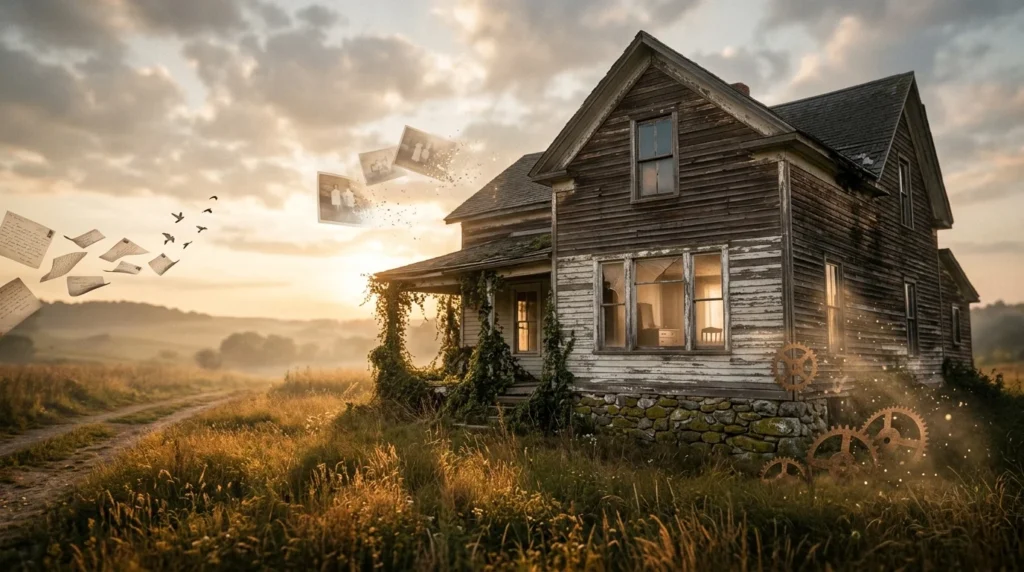
Have you ever tried to describe an old house in a story or poem, but the words felt flat?
Many writers reach for simple descriptions like “run-down” or “abandoned.” But sometimes, an old house feels bigger than that. It can feel lonely. Haunted. Wise. Forgotten. Full of memories.
That is why people search for a good metaphor for old house ideas.
A strong metaphor turns a plain building into something alive inside the reader’s mind. Suddenly, the house becomes a sleeping giant, a fading photograph, or a wounded heart. That tiny change creates a stronger image.
Writers use metaphors to create emotion, symbolism, and visual language. They help readers feel the dust in the air, hear the creaking floors, and imagine the stories hidden behind cracked windows.
Here’s the simple trick: an old house is rarely just a house in creative writing. It often represents memory, time, loneliness, family history, decay, or forgotten dreams.
Let’s explore the most beautiful and powerful ways to describe one.
What Is a Metaphor for an Old House?
A metaphor for an old house compares the house to something else to create emotional or symbolic meaning without using “like” or “as.”
In figurative language, metaphors help writers paint stronger mental pictures.
Instead of saying:
- “The house was old.”
You might say:
- “The house was a tired skeleton standing against the wind.”
That sentence creates imagery and emotion instantly.
Writers use old-house metaphors because they add:
- atmosphere
- symbolism
- poetic expression
- emotional imagery
- storytelling depth
An old house can symbolize:
- fading memories
- lost family history
- loneliness
- survival
- wisdom
- decay
- hidden secrets
Think about it this way: the house becomes a character instead of a background object.
Quick List of Metaphor for Old House Examples
Here are easy copy-and-paste metaphor examples for creative writing, poetry, captions, and school assignments.
- The old house was a sleeping giant. — Quiet but powerful
- The mansion was a fading photograph. — Full of old memories
- The cottage stood as a wounded soldier. — Damaged but surviving
- The house was a forgotten diary. — Filled with hidden stories
- The building was a ghost trapped in wood and stone. — Haunting imagery
- The farmhouse was a tired grandmother. — Warm but aging
- The old cabin was a broken clock. — Frozen in time
- The house was a hollow shell. — Empty and lifeless
- The mansion was a crumbling crown. — Once beautiful and proud
- The house stood as a graveyard of memories. — Sad and emotional
- The cottage was a weary traveler. — Exhausted from time
- The old home was a dusty museum. — Preserving the past
- The building was a scar across the hill. — Dark visual imagery
- The house was a silent storyteller. — Full of history
- The mansion was a dying ember. — Fading beauty
- The old house was a paper heart in the rain. — Fragile symbolism
- The cabin was a lonely lighthouse without light. — Isolation imagery
- The home was a cage for forgotten dreams. — Emotional symbolism
- The house was a skeleton wrapped in ivy. — Gothic atmosphere
- The mansion was a sinking ship. — Falling apart slowly
- The old home was a time capsule. — Holding the past
- The house stood like an ancient king losing his kingdom. — Regal decay
- The cottage was a whisper from another century. — Poetic and mysterious
- The house was a fading candle in the dark. — Soft emotional imagery
- The old building was a cracked mirror of the past. — Reflecting lost memories
Beautiful Metaphors for an Old House
Some metaphors feel soft and emotional. Others feel dark and cinematic.
Here are some vivid examples writers love using.
The House Was a Sleeping Giant
This metaphor creates mystery and quiet power.
Example:
“At the edge of the forest, the old house rested like a sleeping giant beneath tangled vines.”
Most writers use this because it makes the building feel alive.
The House Was a Fading Photograph
This metaphor suggests memory and nostalgia.
Example:
“The old family home sat beneath the gray sky, a fading photograph no one wanted to throw away.”
That image instantly feels emotional.
The House Was a Skeleton
This is common in dark descriptive writing.
Example:
“The house was a skeleton of splintered beams and shattered windows.”
The metaphor emphasizes decay and emptiness.
The House Was a Forgotten Diary
This metaphor adds symbolism and hidden history.
Example:
“Every creaking stair inside the house felt like another page from a forgotten diary.”
This works beautifully in storytelling and poetry.
The House Was a Dying Ember
This metaphor creates gentle sadness.
Example:
“The old cabin glowed at sunset like a dying ember refusing to disappear.”
Small emotional images often stay with readers longer.
Poetic and Deep Metaphor for Old House Ideas
If you want artistic or literary-style imagery, these examples work wonderfully.
Poetic Examples
- The house was winter wearing wooden bones.
- The mansion was a heartbeat fading beneath dust.
- The old home was a candle melting into memory.
- The cottage was a tired hymn forgotten by time.
- The house stood as a bruise upon the landscape.
- The attic was a nest of sleeping ghosts.
- The old porch was a mouth missing its smile.
- The house was sorrow stitched together with nails.
- The mansion was a kingdom abandoned by joy.
- The old home breathed loneliness through broken windows.
These metaphors use symbolism, imagery, and emotional language together.
This is where many beginners get confused: poetic metaphors do not need to “make perfect sense.” They need to create feeling.
Metaphor for Old House in Creative Writing
Old-house metaphors appear everywhere in creative writing.
Writers use them in:
- horror stories
- fantasy novels
- romance
- poetry
- school essays
- gothic fiction
- descriptive writing exercises
Storytelling Example
“The old mansion crouched beside the lake like a wounded beast guarding ancient secrets.”
That one sentence creates:
- mood
- atmosphere
- visual imagery
- mystery
Poetry Example
“The house was a tired lantern
Flickering against the storm of years.”
Short poetic metaphors often sound more powerful than long descriptions.
School Assignment Example
“The abandoned farmhouse was a time capsule filled with forgotten memories.”
This sounds creative while staying beginner-friendly.
Social Media Caption Example
- “Some old houses carry more memories than people do.”
- “The house stood there like a ghost that forgot how to leave.”
- “Old homes speak softly, but their stories are loud.”
Metaphor vs Simile
| Feature | Metaphor | Simile |
|---|---|---|
| Meaning | Direct comparison | Comparison using “like” or “as” |
| Grammar Style | Says something is something else | Says something is like something else |
| Emotional Impact | Stronger and deeper | Softer and more obvious |
| Example | “The house was a skeleton.” | “The house looked like a skeleton.” |
| Writing Style | More poetic | More conversational |
| Beginner Mistake | Mixing too many images | Overusing “like” repeatedly |
Why People Confuse Metaphors and Similes
Many beginners mix them up because both compare things.
Here’s the easiest way to remember it:
- Metaphor = direct comparison
- Simile = uses “like” or “as”
Example:
- Metaphor: “The house was a graveyard.”
- Simile: “The house looked like a graveyard.”
School lessons sometimes rush through figurative language too quickly. Because of that, students often memorize rules without understanding the feeling behind them.
Think about it this way: metaphors feel bolder and more emotional.
Real-Life Conversation Examples
Classroom Conversation
Student: “I wrote that the house was old.”
Teacher: “Can you make the image stronger?”
Student: “The house was a skeleton left behind by time.”
🎯 Lesson: Metaphors create stronger imagery.
Poetry Writing Conversation
Friend: “Your poem feels flat.”
Writer: “Maybe I need more symbolism.”
Friend: “Try making the house represent memory or loneliness.”
🎯 Lesson: Metaphors add emotional depth.
Social Media Caption Conversation
Person 1: “That abandoned house looks creepy.”
Person 2: “It looks like a ghost wearing wood and brick.”
🎯 Lesson: Visual language makes descriptions memorable.
Storytelling Conversation
Writer: “I want the setting to feel sad.”
Editor: “Then let the house mirror the emotion.”
🎯 Lesson: Setting can reflect character emotions.
How to Create Your Own Metaphor for Old House
You do not need to sound like a famous poet.
Here’s the simple trick: focus on emotion first.
Step 1: Choose a Feeling
Ask yourself:
What does the house feel like?
- lonely
- haunted
- warm
- forgotten
- peaceful
- broken
Step 2: Find Something With the Same Feeling
Example:
Lonely → ghost
Broken → skeleton
Warm → grandmother
Forgotten → dusty diary
Step 3: Turn It Into a Direct Comparison
Instead of:
- “The house felt lonely.”
Write:
- “The house was a lonely ghost at the end of the road.”
That tiny change creates a stronger image.
Step 4: Add Sensory Imagery
Use sounds, textures, and visuals.
Example:
“The old house was a weary giant groaning beneath the storm.”
Now the reader can almost hear it.
Common Mistakes Beginners Make
Using Too Many Metaphors at Once
❌ “The house was a ghost, a skeleton, a storm, and a graveyard.”
Why it happens:
- Writers get excited and overload the sentence.
✅ Better Version:
- “The house was a skeleton beneath the moonlight.”
Making the Metaphor Confusing
❌ “The house was a swimming thunderstorm of clocks.”
Why it happens:
- Random imagery without emotional connection.
✅ Better Version:
- “The house was a broken clock frozen in time.”
Explaining the Metaphor Too Much
❌ “The house was a skeleton because it was old and empty and damaged.”
Why it happens:
- Fear that readers will not understand.
✅ Better Version:
- “The house was a skeleton beneath curling ivy.”
Readers enjoy discovering meaning themselves.
Overusing Dark Imagery
Not every old house must feel scary.
Try softer imagery too:
- “The cottage was a tired grandmother resting beneath autumn trees.”
That feels warm instead of frightening.
Related Figurative Language Terms
Simile
A comparison using “like” or “as.”
Example:
- “The house looked like a forgotten castle.”
Imagery
Language that creates sensory pictures.
Example:
- “Dust floated through the cracked sunlight.”
Personification
Giving human qualities to nonhuman things.
Example:
- “The old house sighed in the wind.”
Symbolism
When an object represents a deeper meaning.
An old house often symbolizes:
- memory
- family history
- loss
- time
Hyperbole
An intentional exaggeration.
Example:
- “The house was older than time itself.”
Famous Symbolism of Old Houses in Literature
Old houses appear constantly in literature because they hold emotional weight.
In gothic fiction, old mansions often symbolize:
- hidden secrets
- family curses
- emotional decay
- isolation
In poetry, cottages and abandoned homes may symbolize:
- nostalgia
- lost childhood
- fading memories
- the passing of time
Many classic writers use houses almost like living characters.
That is why old-house imagery feels so powerful in storytelling.
Frequently Asked Questions
What is a good metaphor for an old house?
A good metaphor for an old house is:
- “The house was a skeleton wrapped in ivy.”
It creates strong visual imagery and symbolism.
Why do writers use old-house metaphors?
Writers use them to create atmosphere, emotion, symbolism, and deeper meaning in creative writing.
What does an old house symbolize?
An old house often symbolizes:
- memory
- loneliness
- history
- family
- decay
- survival
Is “the house was a ghost” a metaphor?
Yes. It directly compares the house to a ghost without using “like” or “as.”
What is the difference between metaphor and imagery?
A metaphor compares two things directly. Imagery creates sensory pictures in the reader’s mind.
Can metaphors improve storytelling?
Yes. Strong metaphors make scenes more emotional, memorable, and visually vivid.
Are old-house metaphors common in poetry?
Very common. Poets often use old houses to represent memory, aging, or emotional loss.
Conclusion
A powerful metaphor for old house can turn a simple setting into something unforgettable.
Instead of describing cracked walls and dusty windows, you give readers emotion, symbolism, and atmosphere. Suddenly, the house becomes a sleeping giant, a fading photograph, or a lonely ghost carrying years of silence.
That is the magic of figurative language.
The best metaphors are not always the fanciest ones. Often, the strongest images come from simple emotions people recognize instantly — loneliness, warmth, memory, or loss.
So the next time you write about an old house, pause for a moment and ask yourself:
What story is the house secretly telling?