
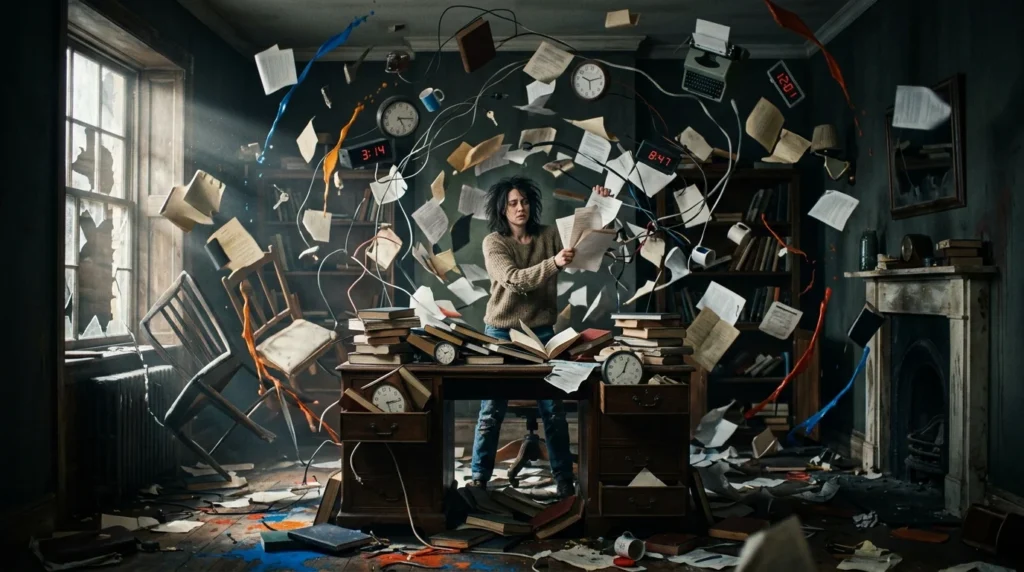
Have you ever looked at a cluttered room, a chaotic situation, or even your own thoughts and felt that the word “mess” just wasn’t strong enough?
Many writers run into this problem. They want a more vivid way to describe disorder, confusion, or chaos. That’s where a metaphor for a mess can help. Instead of simply saying something is messy, a metaphor paints a picture in the reader’s mind.
Think about it this way: saying “the office was a mess” gives information. Saying “the office was a tornado frozen in time” creates an image.
Writers, students, poets, and storytellers often search for metaphors because they make writing more memorable and emotional. Whether you’re working on a school assignment, writing a poem, crafting a story, or creating a social media caption, the right metaphor can bring your words to life.
Let’s explore some of the most creative and useful metaphors for a mess.
What Is a Metaphor for a Mess?
A metaphor for a mess is a figurative expression that compares disorder, chaos, confusion, or clutter to something else without using “like” or “as.”
In simple terms, a metaphor helps readers see a mess in a more vivid way.
Writers use metaphors to:
- Create strong imagery
- Add emotion
- Make descriptions memorable
- Improve storytelling
- Strengthen poetic language
Simple Example
Literal: The room was messy.
Metaphor: The room was a battlefield after the war.
The second sentence instantly creates a stronger image.
A good metaphor for a mess can describe:
- Physical clutter
- Emotional confusion
- Family drama
- Workplace chaos
- Disorganized thoughts
- Complicated situations
Quick List of Metaphor for a Mess Examples
Here are some easy copy-and-paste examples:
- A tornado trapped indoors — extreme chaos
- A battlefield after the fight — destruction and disorder
- A train wreck in slow motion — unfolding disaster
- A tangled ball of yarn — confusion
- A sinking ship — failing situation
- A broken puzzle — scattered pieces
- A jungle without paths — impossible to navigate
- A storm cloud on the ground — visible chaos
- A collapsed house of cards — fragile disorder
- A volcano of clutter — overflowing mess
- A maze with no exit — confusion
- A dumpster fire — embarrassing chaos
- A knot that keeps tightening — growing problems
- A shattered mirror — broken order
- A swarm without a queen — lack of control
- A hurricane in a closet — clutter everywhere
- A cracked dam — chaos spilling out
- A runaway wagon — uncontrollable disorder
- A web of confusion — tangled problems
- A wrecked harbor — complete disorganization
- A pile of unfinished stories — scattered thoughts
- A thunderstorm of paperwork — office mess
- A broken compass — lack of direction
- A crowded crossroads — conflicting choices
- A forest of forgotten things — clutter and neglect
Beautiful Metaphors for a Mess
Some metaphors describe disorder in a surprisingly beautiful way.
A Garden Gone Wild
The mess has grown beyond control, but it still has life and character.
Example:
Her desk was a garden gone wild, covered with notebooks, sketches, and dreams.
A River Overflowing Its Banks
Perfect for describing situations that have become too much to manage.
Example:
His responsibilities became a river overflowing its banks.
A Sky Full of Colliding Clouds
Suggests emotional or mental confusion.
Example:
Her thoughts were a sky full of colliding clouds.
An Orchestra Without a Conductor
Many moving parts but no coordination.
Example:
The project became an orchestra without a conductor.
A Library After an Earthquake
Knowledge exists, but everything is out of place.
Example:
The research notes looked like a library after an earthquake.
Poetic and Deep Metaphor for a Mess Ideas
Poets often use symbolism and emotional imagery to describe chaos.
A Ship Lost in Fog
Represents confusion and uncertainty.
A Broken Constellation
Suggests scattered pieces that once formed a meaningful whole.
A Storm Trapped in a Bottle
Describes hidden turmoil waiting to burst out.
A Cracked Symphony
Something once beautiful now feels disordered.
A Kingdom Without a King
Represents a complete lack of structure.
A Moon Reflected in Shattered Water
Symbolizes beauty disrupted by chaos.
A Forest of Tangled Shadows
Creates dark, mysterious imagery.
A Nest Torn by the Wind
Represents fragile order destroyed suddenly.
Metaphor for a Mess in Creative Writing
Writers use metaphors to make scenes more immersive and emotional.
In Storytelling
Example:
The apartment wasn’t a home anymore. It was a battlefield abandoned after months of fighting.
In Poetry
Example:
My thoughts were a swarm of bees searching for a queen.
In Descriptive Writing
Example:
The garage stood before us, a jungle of forgotten treasures and broken promises.
In School Assignments
Example:
The science project became a train wreck in slow motion after the team missed several deadlines.
In Personal Narratives
Example:
After graduation, my plans felt like a puzzle scattered across the floor.
That tiny change creates a stronger image and helps readers connect emotionally.
Metaphor vs Simile
| Feature | Metaphor | Simile |
|---|---|---|
| Meaning | Direct comparison | Comparison using like or as |
| Grammar | Says something is something else | Says something is like something else |
| Emotional Impact | Stronger and more direct | Softer and more flexible |
| Example | The room was a battlefield. | The room was like a battlefield. |
| Writing Style | Bold imagery | Gentle imagery |
| Beginner Mistake | Taking it literally | Overusing like and as |
Why People Confuse Metaphors and Similes
This is where many beginners get confused.
Both are forms of figurative language.
Both compare one thing to another.
The key difference is simple:
Metaphor
The room was a jungle.
Simile
The room was like a jungle.
A metaphor makes a direct statement.
A simile makes a comparison.
Many students learn them at the same time, which is why they often mix them up.
Real-Life Conversation Examples
School Project
Student: Our group project is a mess.
Teacher: Sounds like it’s become a train wreck in slow motion.
🎯 Lesson: Metaphors make descriptions more vivid.
Poetry Class
Student: My poem feels disorganized.
Teacher: Maybe it’s a tangled ball of yarn waiting to be unraveled.
🎯 Lesson: Metaphors help explain abstract ideas.
Social Media Caption
Friend: How’s your room?
You: It’s a tornado frozen in time.
🎯 Lesson: Metaphors create memorable captions.
Story Writing
Writer: My character’s life is chaotic.
Editor: Then make it a sinking ship in rough seas.
🎯 Lesson: Symbolic imagery adds emotional depth.
Classroom Discussion
Student: Everything feels confusing.
Teacher: Maybe you’re standing in a maze with no exit right now.
🎯 Lesson: Metaphors turn feelings into images.
How to Create Your Own Metaphor for a Mess
Most writers use this because it instantly improves descriptive writing.
Step 1: Think About the Type of Mess
Ask yourself:
- Physical clutter?
- Emotional confusion?
- Workplace chaos?
- Relationship problems?
Step 2: Find a Similar Image
Think of things that feel chaotic:
- Storms
- Tornadoes
- Broken puzzles
- Traffic jams
- Tangled ropes
Step 3: Focus on Emotion
What feeling does the mess create?
- Stress
- Frustration
- Confusion
- Overwhelm
Step 4: Make a Direct Comparison
Instead of:
The room was messy.
Try:
The room was a hurricane trapped between four walls.
That creates stronger imagery, symbolism, and poetic expression.
Common Mistakes Beginners Make
Using Clichés Too Often
Mistake: The room was a pigsty.
Why: Readers have heard it many times.
Better: The room was a forgotten battlefield.
Mixing Metaphors
Mistake: The room was a jungle sailing through a storm.
Why: Two unrelated images clash.
Better: The room was a jungle of forgotten belongings.
Making Metaphors Too Complicated
Mistake: The room was an interdimensional ecosystem of fragmented realities.
Why: Readers may get confused.
Better: The room was a broken puzzle.
Explaining the Metaphor Too Much
Mistake: The room was a tornado, which means everything was messy.
Why: The image should speak for itself.
Better: The room was a tornado frozen in place.
Related Figurative Language Terms
Simile
Compares using “like” or “as.”
Example: The room was like a tornado zone.
Imagery
Language that helps readers see, hear, or feel something.
Personification
Gives human traits to non-human things.
Example: The clutter crept across the floor.
Symbolism
Uses objects or images to represent deeper ideas.
Example: A broken puzzle symbolizes disorder.
Hyperbole
Uses exaggeration.
Example: There were enough papers to bury a city.
Symbolism of Messes in Literature
Throughout literature, messes often symbolize more than physical clutter.
Authors frequently use disorder to represent:
- Emotional struggles
- Inner conflict
- Social chaos
- Family problems
- Loss of control
- Personal transformation
A messy room might symbolize a troubled mind.
A cluttered desk might represent creative energy.
A ruined city might symbolize the collapse of order.
This is why metaphors involving chaos appear so often in poetry, novels, and storytelling.
Frequently Asked Questions
What is a good metaphor for a mess?
A good metaphor for a mess is “a tornado frozen in time” because it instantly creates an image of chaos and disorder.
What is a poetic metaphor for a mess?
A poetic metaphor is “a broken constellation”, suggesting scattered pieces that once formed a beautiful whole.
What metaphor describes a messy room?
A messy room can be described as a battlefield, a jungle, or a hurricane trapped indoors.
What is a metaphor for emotional messiness?
Try “a storm trapped in a bottle” or “a sky full of colliding clouds.”
Is a metaphor stronger than a simile?
Often yes. Metaphors feel more direct because they make a comparison instead of suggesting one.
Can metaphors be used in school essays?
Absolutely. They improve descriptive writing and make essays more engaging.
What figurative language is similar to a metaphor?
Similes, symbolism, imagery, personification, and hyperbole are closely related literary devices.
How do I create my own metaphor?
Choose the feeling you want to describe, find a similar image, and make a direct comparison.
Conclusion
A strong metaphor for a mess does much more than describe clutter. It transforms ordinary disorder into something readers can see, feel, and remember. Whether you choose a tornado frozen in time, a tangled ball of yarn, a broken constellation, or a battlefield after the fight, the right metaphor adds depth and emotion to your writing.
The best part is that there is no single perfect metaphor. Every writer sees chaos differently. Some see storms. Others see puzzles, jungles, or shattered mirrors.
Keep experimenting with imagery, symbolism, and creative comparisons. The more you practice, the easier it becomes to turn even the messiest ideas into powerful and memorable writing.