
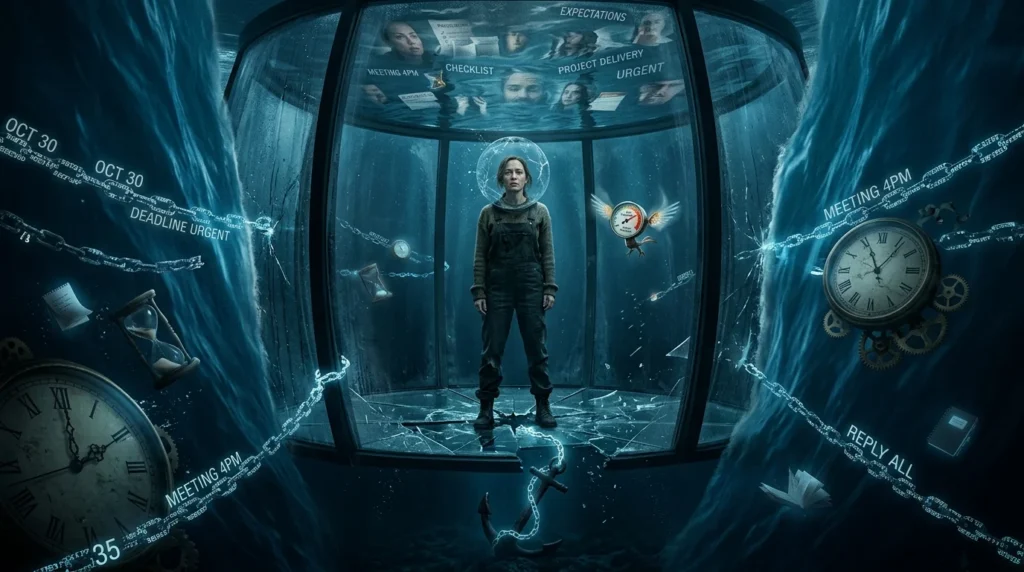
When you sit down to write an essay and your mind suddenly feels tight, like there’s no space to think, you’re already living inside a metaphor for being under pressure. Writers often search for this phrase because they want to describe stress in a more creative, emotional, and visual way. Instead of simply saying “I am stressed,” they want language that shows the feeling.
That’s where metaphors become powerful.
People often feel confused about how to express pressure in writing. Is it a weight? A storm? A ticking clock? The truth is, pressure can be anything your imagination turns it into. And once you learn how to shape it, your writing becomes more alive, more human, and much more memorable. Let’s explore it step by step in a simple, beginner-friendly way.
What Is a Metaphor for Being Under Pressure?
A metaphor for being under pressure is a figure of speech that describes stress or tension by comparing it to something physical, emotional, or natural—without using “like” or “as.”
Simple definition (snippet-ready):
A metaphor for being under pressure is a comparison that shows stress as a physical force, object, or situation that feels heavy, tight, or overwhelming.
Writers use it because it helps readers feel the emotion instead of just understanding it.
For example:
- “I was a boiling kettle ready to explode.”
- “The deadline sat on my chest like a stone.” (note: this becomes simile if “like” is used)
- “My mind was a room with no air.”
These images make emotional pressure visible.
Why it matters in creative writing:
- It turns invisible stress into something physical
- It builds emotional connection with readers
- It makes storytelling more vivid and real
Pressure becomes something you can see, not just something you feel.
Quick List of Metaphors for Being Under Pressure Examples
Here are easy copy-paste metaphors you can use in writing:
- A ticking bomb inside my chest — sudden emotional overload
- A kettle about to burst — rising stress
- A shrinking room — feeling trapped by pressure
- A heavy backpack of stones — carrying emotional burden
- A storm building in my mind — growing anxiety
- A cracked glass ready to shatter — fragile mental state
- A furnace burning too hot — intense pressure
- A sinking ship — feeling overwhelmed and lost
- A tightening rope around my thoughts — mental restriction
- A pressure cooker with no release — emotional buildup
- A glass filled to the edge — no room for more stress
- A battlefield inside my head — inner conflict
- A collapsing bridge — breaking under responsibility
- A volcano waiting to erupt — suppressed emotion
- A cage closing in — emotional confinement
- A burning candle melting too fast — exhaustion under stress
- A wave crashing over me — sudden overwhelm
- A tight knot in my chest — emotional tension
- A clock ticking louder than my thoughts — urgency pressure
- A snowball growing too fast — problems increasing quickly
Each one gives pressure a shape your reader can imagine.
Beautiful Metaphors for Being Under Pressure
Some metaphors feel softer but still powerful:
- “My thoughts were clouds too heavy to float.”
- “I was a balloon stretched thin by invisible hands.”
- “Every expectation was another drop in an already full cup.”
- “My heart was a drum beating too fast for calm.”
- “I stood under a sky made of deadlines.”
These are useful when you want emotional depth without sounding harsh.
That tiny change creates a stronger image.
Poetic and Deep Metaphor for Being Under Pressure Ideas
Here’s where writing becomes more artistic:
- “I am ink pressed too hard onto fragile paper.”
- “The world is a hand squeezing time from my fingers.”
- “Silence presses on me like deep ocean water.”
- “My soul is a rope stretched between two breaking points.”
- “Expectation is a crown made of burning metal.”
These metaphors are often used in poetry, novels, and song lyrics because they carry symbolism and emotion together.
They don’t just describe pressure—they perform it.
Metaphor for Being Under Pressure in Creative Writing
Writers use pressure metaphors in many ways:
In storytelling:
- To show a character breaking down
- To build tension before a climax
In poetry:
- To express emotional overload
- To symbolize life struggles
In school essays:
- To describe exams or deadlines
- To show personal challenges
Example in a story:
“The deadline was a shadow following me everywhere. Even when I closed my eyes, it stood there waiting.”
Example in poetry:
“I carry hours like stones in my pocket,
each one heavier than the last.”
Most writers use this because it turns simple stress into imagery.
Metaphor vs Simile
| Feature | Metaphor | Simile |
|---|---|---|
| Meaning | Direct comparison | Uses “like” or “as” |
| Example | “I am a volcano” | “I am like a volcano” |
| Impact | Stronger, deeper | Softer, clearer |
| Emotion | More intense | More descriptive |
| Beginner mistake | Mixing both styles | Overusing “like/as” |
Metaphors feel more powerful because they become the thing they describe.
Why People Confuse Metaphors and Similes
This confusion is very common for beginners.
Here’s why:
- School teaches both together
- Both compare things
- Sentence structure looks similar
- Students fear making mistakes
Simple trick:
- If it says “like” or “as” → simile
- If it directly says “is” or “becomes” → metaphor
That tiny rule solves most confusion instantly.
Real-Life Conversation Examples
1. Classroom stress
Teacher: “How do you feel before exams?”
Student: “Like I’m a pressure cooker ready to explode.”
🎯 Lesson: Pressure becomes easier to explain with imagery.
2. Poetry writing
Friend: “Why so quiet?”
Writer: “My thoughts are a room with no air today.”
🎯 Lesson: Metaphors express emotion without long explanations.
3. Social media caption
Post: “Work deadlines are a storm I can’t step out of.”
🎯 Lesson: Short metaphors create strong captions.
4. Storytelling moment
Character: “Everything feels like it’s collapsing at once.”
🎯 Lesson: Pressure builds drama in stories.
How to Create Your Own Metaphor for Being Under Pressure
Here’s the simple trick…
Think of pressure as:
- Something heavy (stone, weight, backpack)
- Something tight (rope, cage, knot)
- Something explosive (bomb, volcano, kettle)
- Something natural (storm, wave, earthquake)
Now ask:
“What does my stress feel like physically?”
Then convert it:
- Stress → object or force
- Emotion → image
- Feeling → action
Example:
“I feel stressed about exams” →
“My exams are a storm gathering over my head.”
That’s all you need.
Common Mistakes Beginners Make
- Using too many metaphors in one sentence — it becomes confusing
- Mixing simile and metaphor accidentally — weakens impact
- Choosing random objects — makes no emotional sense
- Overcomplicating language — reduces clarity
- Repeating the same idea — feels robotic
Fix: keep it simple, visual, and emotional.
Related Figurative Language Terms
- Simile: comparison using like/as
- Imagery: language that appeals to senses
- Personification: giving human traits to objects
- Symbolism: using objects to represent ideas
- Hyperbole: extreme exaggeration for effect
These all work together with metaphors.
Frequently Asked Questions
What is a metaphor for being under pressure?
It is a comparison that shows stress as a physical force like a storm, weight, or explosion.
What is the best metaphor for stress?
“A pressure cooker ready to explode” is one of the most common and effective.
Can metaphors describe emotional pressure?
Yes, they make emotions feel physical and easier to understand.
What is a simple pressure metaphor for students?
“My exams are a heavy backpack I can’t put down.”
Why do writers use pressure metaphors?
To make emotions vivid, relatable, and memorable.
Is “like a storm” a metaphor?
No, it is a simile because it uses “like.”
Conclusion
Pressure is something everyone feels, but words can turn it into something meaningful and beautiful. When you use a metaphor for being under pressure, you transform invisible stress into images your reader can see, feel, and remember.
A storm, a weight, a ticking clock—each one gives emotion a shape. And once you learn this skill, your writing stops being plain and starts becoming expressive and alive.
You don’t just say you feel pressure anymore.
You show it breathing through your words.