
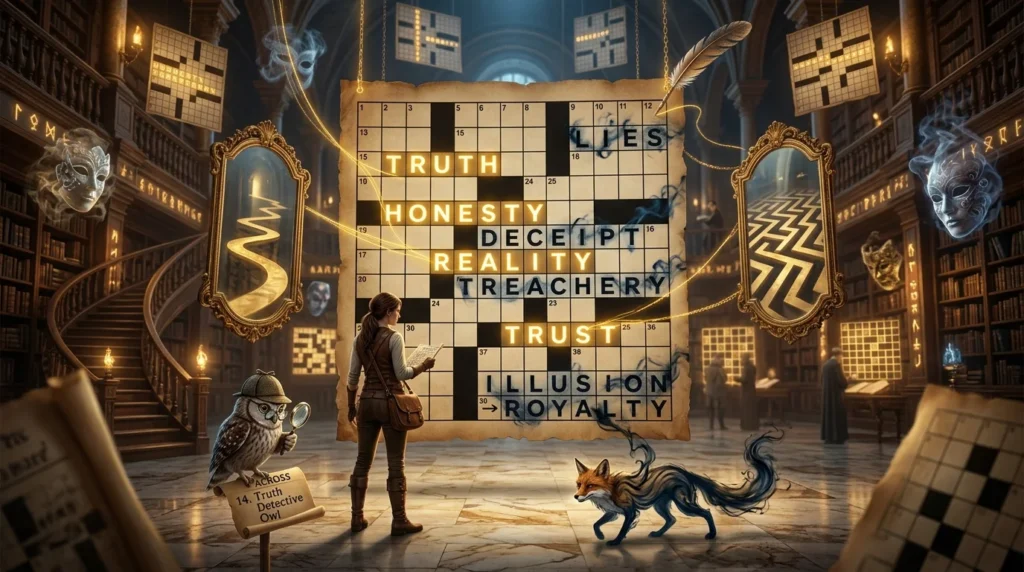
Have you ever been working on a crossword puzzle and found yourself stuck on a clue like “metaphor for lies”? It happens more often than you might think. Crossword creators love figurative language because it adds layers of meaning and challenges solvers to think beyond literal definitions.
When people search for a metaphor for lies crossword clue, they are often looking for a specific answer, but they may also want to understand why certain words symbolize deception, dishonesty, or hidden truths. Writers, poets, students, and puzzle enthusiasts all encounter these metaphors in different ways.
Language becomes more interesting when we use imagery instead of plain descriptions. Rather than simply saying someone lied, a writer might describe lies as smoke, shadows, masks, or webs. These images create emotion and help readers visualize abstract ideas.
Understanding these metaphors can improve your crossword-solving skills while also making your creative writing stronger. Let’s explore the meanings behind some of the most common metaphorical expressions for lies.
What Is a Metaphor for Lies?
A metaphor for lies is a figurative expression that compares deception to something else without using “like” or “as.”
In simple terms, a metaphor turns an abstract idea into a vivid image.
Writers use metaphors for lies because they make dishonesty easier to picture and understand.
Examples
- Lies are a web.
- Lies are shadows.
- Lies are smoke.
- Lies are masks.
- Lies are poison.
Each metaphor highlights a different aspect of deception.
For example:
- A web suggests entanglement.
- A shadow suggests hidden truth.
- A mask suggests concealment.
- Smoke suggests confusion.
These images create stronger emotional impact than simply saying “someone lied.”
Quick List of Metaphor for Lies Examples
- Web of deceit — lies trap people.
- House of cards — lies collapse easily.
- Smoke screen — hides the truth.
- Mask — conceals reality.
- Shadow — obscures facts.
- Poison — damages trust.
- Fog — creates confusion.
- Mirage — appears real but isn’t.
- Puppet strings — manipulation through lies.
- Labyrinth — difficult to escape deception.
- Cracked mirror — distorted truth.
- Dark cloud — dishonesty hanging overhead.
- Sandcastle — unstable falsehood.
- False beacon — misleading guidance.
- Rotten fruit — corruption beneath the surface.
- Snake in the grass — hidden deceit.
- Curtain — covering reality.
- Iceberg — hidden truths beneath lies.
- Broken compass — misleading direction.
- Black hole — swallowing facts.
- Disguise — false appearance.
- Thorn bush — painful deception.
- Maze — confusion caused by lies.
- Tarnished silver — damaged honesty.
- Hollow tree — empty promises.
Beautiful Metaphors for Lies
The Velvet Mask
A lie can feel smooth and comforting at first.
Yet beneath the soft surface hides deception.
A Garden of Plastic Flowers
Everything looks beautiful.
Nothing is real.
The Painted Window
It appears transparent.
In reality, you cannot see through it.
A Moon Without Light
It reflects truth but creates no truth of its own.
The Silent Shadow
Always following.
Never revealing itself fully.
Poetic and Deep Metaphor for Lies Ideas
Writers often use deeper imagery to explore dishonesty.
Lies Are Ghosts
Past deceptions continue haunting relationships.
Lies Are Winter Frost
They seem delicate but can kill growth beneath them.
Lies Are Borrowed Feathers
They create beauty using something that doesn’t belong to them.
Lies Are Cracks in a Foundation
Small at first.
Dangerous over time.
Lies Are Sleeping Dragons
Quiet now.
Destructive when awakened.
Lies Are Drowning Stars
Truth exists but struggles to shine.
Metaphor for Lies in Creative Writing
Creative writers use metaphors to make emotions more powerful.
Storytelling Example
“The lie sat between them like a locked door.”
The image instantly suggests separation and mistrust.
Poetry Example
“His promises were smoke drifting through open hands.”
This metaphor emphasizes emptiness and impermanence.
Descriptive Writing Example
“Every excuse became another thread in the web he was weaving.”
The image suggests increasing complexity.
School Assignment Example
“The rumor spread through the classroom as a wildfire of lies.”
The metaphor creates vivid imagery.
Social Media Caption Example
“Some masks are made of smiles.”
Short, symbolic, and memorable.
Metaphor vs Simile
| Feature | Metaphor | Simile |
|---|---|---|
| Meaning | Direct comparison | Comparison using like or as |
| Grammar | Says one thing is another | Says one thing is like another |
| Emotional Impact | Stronger and more direct | Softer and more descriptive |
| Example | Lies are poison | Lies are like poison |
| Example | His words were smoke | His words were like smoke |
| Common Mistake | Taking metaphor literally | Overusing like and as |
Why People Confuse Metaphors and Similes
This is where many beginners get confused.
Both are forms of figurative language.
Both create imagery.
Both help with descriptive writing.
The key difference is simple.
Metaphor
“His story was a house of cards.”
Simile
“His story was like a house of cards.”
The first is a metaphor.
The second is a simile.
That tiny change creates a stronger image.
Real-Life Conversation Examples
School
Student: “Why did the teacher call his excuse a smoke screen?”
Teacher: “Because it was hiding the truth.”
🎯 Lesson: Smoke often symbolizes deception.
Classroom Writing
Student: “Can I say lies are shadows?”
Teacher: “Yes. Shadows hide details and make things unclear.”
🎯 Lesson: Shadows symbolize hidden truth.
Poetry Workshop
Writer: “My poem says deception is a web.”
Mentor: “That works because webs trap people.”
🎯 Lesson: Good metaphors connect image and meaning.
Social Media
Friend: “Why did your caption mention masks?”
Writer: “Because people sometimes hide their real intentions.”
🎯 Lesson: Masks symbolize concealment.
Storytelling
Reader: “Why compare lies to fog?”
Author: “Because fog makes it difficult to see clearly.”
🎯 Lesson: Strong metaphors create visual language.
How to Create Your Own Metaphor for Lies
Think about it this way.
Ask yourself:
What does a lie do?
- Hide truth?
- Create confusion?
- Cause harm?
- Manipulate people?
Find an Image
Match the effect with an object.
| Effect | Possible Metaphor |
|---|---|
| Hiding truth | Curtain |
| Confusion | Fog |
| Harm | Poison |
| Trapping people | Web |
| Distorting reality | Mirror |
Add Emotion
Instead of saying:
“Lies are a web.”
Try:
“Lies are a spider’s web stretched across trust.”
The image becomes stronger and more memorable.
Common Mistakes Beginners Make
Using Clichés Too Often
❌ Lies are poison.
✅ Lies were slow poison dissolving trust.
Why it happens:
People stop at the first idea.
Mixing Images
❌ Lies are a web that burns like ice.
✅ Lies are a web tightening around the truth.
Why it happens:
Too many unrelated images create confusion.
Making the Metaphor Too Literal
❌ The lie was a lie.
✅ The lie was a curtain blocking daylight.
Why it happens:
The comparison isn’t vivid enough.
Overexplaining
❌ Lies are smoke because smoke hides things and therefore deception is hidden.
✅ Lies were smoke drifting across the room.
Why it happens:
Writers explain instead of showing.
Related Figurative Language Terms
Simile
Compares two things using “like” or “as.”
Example:
“Lies spread like wildfire.”
Imagery
Language that creates mental pictures.
Example:
“A fog of deception covered the town.”
Personification
Gives human qualities to nonhuman things.
Example:
“The lie crept through the crowd.”
Symbolism
Uses objects to represent ideas.
Example:
A mask symbolizes deception.
Hyperbole
Uses exaggeration for effect.
Example:
“That lie was big enough to cover the sky.”
Symbolism of Lies in Literature
Throughout literature, deception often appears through symbols rather than direct statements.
Common symbols include:
- Masks
- Mirrors
- Shadows
- Fog
- Labyrinths
- Snakes
- Curtains
- Dark clouds
Authors use these symbols because they help readers feel uncertainty, mistrust, and mystery.
From classic novels to modern poetry, symbolic imagery remains one of the strongest writing techniques for exploring truth and deception.
Frequently Asked Questions
What is the best metaphor for lies?
A web of deceit is one of the most common and effective metaphors because it suggests entrapment and manipulation.
What is a crossword answer for metaphor for lies?
Common crossword answers may include web, mask, smoke screen, shadow, or deceit, depending on clue length.
Is “lies are poison” a metaphor?
Yes. It directly compares lies to poison without using “like” or “as.”
What is the difference between a metaphor and a symbol?
A metaphor makes a comparison, while a symbol represents a larger idea.
Why do writers use metaphors for lies?
They create stronger imagery, emotion, and understanding than literal descriptions.
Can metaphors help in creative writing?
Yes. Metaphors make stories, poems, and descriptions more vivid and memorable.
What symbol is commonly associated with lies?
Masks and shadows are among the most common symbols of deception.
Conclusion
Understanding a metaphor for lies crossword clue is about more than finding a puzzle answer. It opens the door to richer language, stronger imagery, and more creative thinking. Whether you encounter a web of deceit, a smoke screen, a shadow, or a mask, each metaphor reveals something unique about how humans understand dishonesty.
The best metaphors transform abstract ideas into images we can see and feel. They strengthen poetry, storytelling, descriptive writing, and even everyday communication. The next time you see a crossword clue about lies, you may solve it faster—and appreciate the deeper symbolism behind the answer. Language is full of hidden images, and learning to spot them makes every word a little more meaningful.