
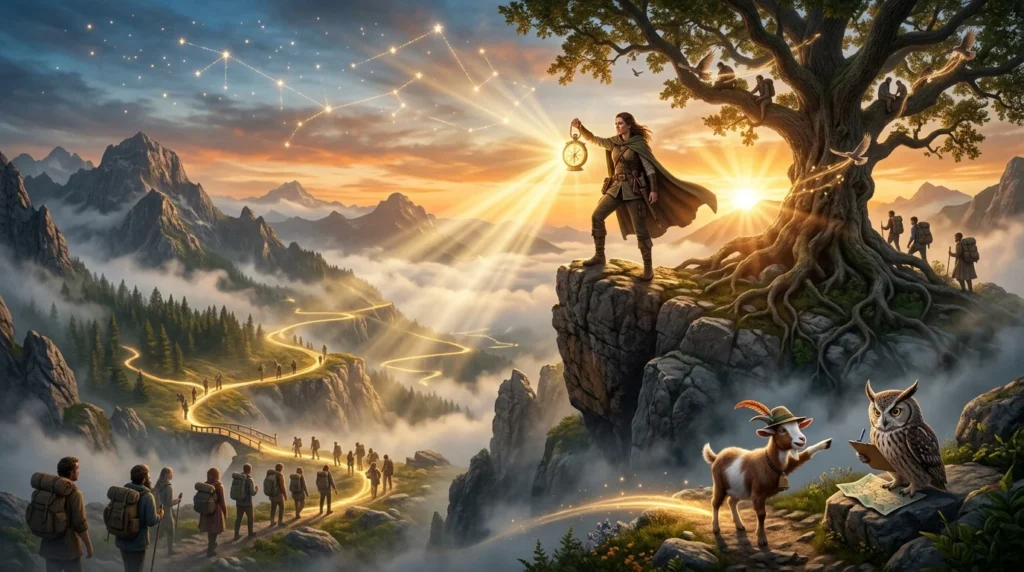
Have you ever tried to describe a great leader and felt that words like strong, smart, or confident were not enough?
Many writers, students, speakers, and poets search for a metaphor for leaders because metaphors create a stronger image. Instead of simply saying someone is a good leader, you can compare them to a lighthouse, a compass, or a bridge. These images instantly help readers understand what kind of leader you mean.
This is why metaphors appear everywhere—from school essays and business speeches to novels and inspirational quotes. A well-chosen metaphor can make leadership feel visible, emotional, and memorable.
The challenge is finding a metaphor that matches the exact type of leader you want to describe. Some leaders guide people through storms. Others inspire growth, protect teams, or create new paths forward.
In this guide, you’ll discover creative examples, poetic imagery, practical writing tips, and meaningful symbolism to help you find the perfect metaphor for leaders.
Lorem ipsum dolor sit amet, consectetur adipiscing elit. Ut elit tellus, luctus nec ullamcorper mattis, pulvinar dapibus leo.
Lorem ipsum dolor sit amet, consectetur adipiscing elit. Ut elit tellus, luctus nec ullamcorper mattis, pulvinar dapibus leo.
What Is a Metaphor for Leaders?
A metaphor for leaders is a figurative comparison that describes a leader as something else to highlight their qualities, influence, or role.
In figurative language, a metaphor helps readers picture leadership through vivid imagery rather than plain description.
For example:
- A leader is a lighthouse.
- A leader is a compass.
- A leader is the captain of the ship.
Writers use metaphors because they create stronger imagery, deeper symbolism, and more memorable descriptions.
Instead of listing traits, a metaphor paints a picture.
Think about it this way: saying “she is a strong leader” tells us something. Saying “she is a lighthouse in rough seas” helps us feel it.
Quick List of Metaphor for Leaders Examples
Here are some easy-to-use metaphors with their meanings.
- A lighthouse — guides others through uncertainty
- A compass — provides direction
- A captain — steers a group toward success
- A bridge — connects people and ideas
- The North Star — offers constant guidance
- A shepherd — protects and guides
- An oak tree — symbolizes strength and stability
- A torch — lights the way forward
- A gardener — helps others grow
- A conductor — brings different talents together
- A beacon — inspires hope
- A mountain — stands firm under pressure
- An architect — designs the future
- A foundation — supports everyone else
- A river — moves people forward
- A pathfinder — discovers new opportunities
- A sail — drives progress
- A sunrise — brings new beginnings
- A cornerstone — essential for success
- A watchtower — sees challenges early
- A flame — inspires passion
- A shield — protects the team
- A guidepost — points the way
- A key — unlocks potential
- A bridge builder — creates unity
- A gardener of dreams — nurtures ambitions
- A drumbeat — keeps everyone moving together
- A map — provides clarity
- A harbor — offers safety and support
- A windmill — turns challenges into opportunity
Beautiful Metaphors for Leaders
Some metaphors focus on the emotional side of leadership.
A Lighthouse
A lighthouse stands firm while storms rage around it.
Example:
“When the company faced uncertainty, Maria became a lighthouse for her team.”
This metaphor suggests calmness, guidance, and reliability.
A Gardener
Great leaders often help others grow rather than seeking attention themselves.
Example:
“He was a gardener, planting confidence in every member of the team.”
This creates an image of patience and development.
A Bridge
Leadership often involves bringing people together.
Example:
“She became a bridge between departments that rarely worked together.”
The symbolism highlights connection and cooperation.
A Beacon
A beacon shines from a distance and attracts attention.
Example:
“His integrity became a beacon for the entire organization.”
This metaphor emphasizes inspiration and moral leadership.
The North Star
For centuries, travelers relied on the North Star for navigation.
Example:
“Her vision served as the North Star for the project’s future.”
This symbolizes consistency and direction.
Poetic and Deep Metaphor Ideas for Leaders
If you’re writing poetry, speeches, or reflective essays, these metaphors offer deeper symbolism.
A River Cutting Through Stone
Leadership often requires persistence.
Example:
“She was a river carving pathways through impossible terrain.”
The image suggests quiet determination.
A Flame in the Darkness
This metaphor represents hope during difficult times.
Example:
“He remained a flame when fear darkened every room.”
A Tree with Endless Roots
Roots symbolize wisdom, experience, and stability.
Example:
“The leader stood like an ancient tree whose roots held the community together.”
A Sunrise Over the Horizon
Sunrises symbolize fresh beginnings.
Example:
“Her leadership arrived like a sunrise after a long night.”
A Forge
A forge transforms raw metal into something stronger.
Example:
“He was a forge, shaping ordinary challenges into extraordinary growth.”
Metaphor for Leaders in Creative Writing
Most writers use metaphors because they create memorable characters and stronger emotional imagery.
In Stories
Instead of writing:
“The king was a good leader.”
Write:
“The king was a lighthouse standing against centuries of storms.”
That tiny change creates a stronger image.
In Poetry
Poetry thrives on symbolism.
Example:
“You were the compass hidden in my pocket,
guiding me through every wandering season.”
In School Assignments
Teachers often appreciate vivid descriptive writing.
Example:
“Nelson Mandela was a bridge that connected divided communities.”
In Speeches
Leadership speeches become more inspiring with metaphorical language.
Example:
“Together, we can become the architects of a better future.”
Metaphor vs Simile
| Feature | Metaphor | Simile |
|---|---|---|
| Meaning | Direct comparison | Comparison using “like” or “as” |
| Grammar | Says one thing is another | Says one thing is like another |
| Emotional Impact | Usually stronger | Usually gentler |
| Example | The leader is a lighthouse. | The leader is like a lighthouse. |
| Imagery | More immediate | More explanatory |
| Common Beginner Mistake | Taking it literally | Overusing “like” |
Quick Rule
A metaphor says:
“The leader is a compass.”
A simile says:
“The leader is like a compass.”
Why People Confuse Metaphors and Similes
This is where many beginners get confused.
Both metaphors and similes compare two different things.
The difference is simple:
- Metaphors make a direct comparison.
- Similes use like or as.
Many students see both as forms of figurative language and assume they are identical.
They are closely related, but they work differently.
A metaphor creates a stronger illusion that the comparison is real.
A simile keeps the comparison more obvious.
Real-Life Conversation Examples
School Project
Student: Who led the group project?
Teacher: Emma was the compass for the entire team.
🎯 Lesson: Leaders often provide direction.
Poetry Class
Student: How can I describe a leader poetically?
Teacher: Try calling them a lighthouse or a North Star.
🎯 Lesson: Leadership metaphors create vivid imagery.
Social Media Caption
Friend: How would you describe your mentor?
Friend 2: She’s the bridge that helped me cross every obstacle.
🎯 Lesson: Metaphors make compliments more memorable.
Storytelling
Writer: My character leads a rebellion.
Editor: Think of him as a flame spreading courage.
🎯 Lesson: Symbolic imagery strengthens storytelling.
Classroom Discussion
Student: Why do people admire great leaders?
Teacher: Because they become beacons during difficult times.
🎯 Lesson: Leadership often symbolizes hope.
How to Create Your Own Metaphor for Leaders
Creating metaphors is easier than most beginners think.
Think About the Leader’s Main Quality
Ask yourself:
- Do they guide people?
- Protect people?
- Inspire people?
- Unite people?
Find an Object That Does the Same Thing
Examples:
- Guides → lighthouse
- Protects → shield
- Connects → bridge
- Inspires → flame
Add Symbolism
Ask:
“What image best represents that quality?”
This creates richer poetic language and stronger descriptive writing.
Use Nature
Nature symbolism often creates powerful metaphors.
Examples:
- Oak tree
- River
- Mountain
- Sunrise
- Eagle
- Forest path
These images feel timeless and emotional.
Common Mistakes Beginners Make
Choosing Random Comparisons
Mistake:
“The leader was a spoon.”
Why it happens:
The comparison has no clear connection.
Better:
“The leader was a compass.”
Mixing Too Many Metaphors
Mistake:
“She was a lighthouse, river, airplane, and mountain.”
Why it happens:
Writers try to include too many images.
Better:
Choose one strong metaphor.
Explaining Too Much
Mistake:
Writing several sentences explaining the metaphor.
Why it happens:
Fear that readers won’t understand.
Better:
Trust the image.
Using Clichés Repeatedly
Mistake:
Using the same metaphor over and over.
Better:
Experiment with fresh imagery.
Related Figurative Language Terms
Simile
A comparison using like or as.
Example:
“The leader was like a lighthouse.”
Imagery
Language that creates mental pictures.
Example:
“The torch flickered against the dark horizon.”
Personification
Giving human traits to non-human things.
Example:
“The city welcomed its new leader.”
Symbolism
Using an object to represent a deeper meaning.
Example:
A torch may symbolize hope or guidance.
Hyperbole
Intentional exaggeration.
Example:
“She carried the entire world on her shoulders.”
Leadership Symbolism in Literature
Throughout literature, leaders often appear through symbols rather than direct descriptions.
Ancient stories used kings as mountains, stars, and mighty trees. Epic heroes were compared to lions, eagles, and guiding lights. These symbols helped readers understand power, wisdom, courage, and responsibility.
Even today, authors use leadership metaphors because they instantly communicate complex qualities.
A single image can reveal more about a character than an entire paragraph of explanation.
Frequently Asked Questions
What is the best metaphor for a leader?
A lighthouse is one of the most popular metaphors because it symbolizes guidance, stability, and hope.
What metaphor symbolizes leadership?
Common leadership symbols include a compass, torch, captain, bridge, and North Star.
How do you describe a leader using figurative language?
Compare the leader to something that reflects their role, such as a lighthouse guiding ships or a gardener helping plants grow.
Is “leader is a lighthouse” a metaphor?
Yes. It directly compares a leader to a lighthouse without using “like” or “as.”
What is a poetic metaphor for leadership?
A poetic example is: “She was the sunrise that awakened sleeping possibilities.”
What metaphor represents a strong leader?
An oak tree, mountain, or fortress often symbolizes strength and resilience.
What metaphor represents inspirational leadership?
A flame, beacon, or torch can symbolize inspiration and motivation.
Can metaphors improve creative writing?
Yes. Metaphors add imagery, symbolism, emotional depth, and memorable descriptions.
Conclusion
A powerful metaphor for leaders does more than describe a person—it creates an image readers can instantly see and feel. Whether you choose a lighthouse, a compass, a bridge, a flame, or an ancient oak tree, the right metaphor turns leadership into something vivid and memorable.
As you practice creative writing, pay attention to the qualities you want to highlight. Is the leader guiding others, protecting them, inspiring them, or helping them grow? Once you know the answer, finding the perfect metaphor becomes much easier.
The best metaphors are often the simplest ones. They connect emotion, symbolism, and imagery in a way that feels natural. Keep experimenting, trust your imagination, and you’ll discover leadership metaphors that bring your writing to life.