
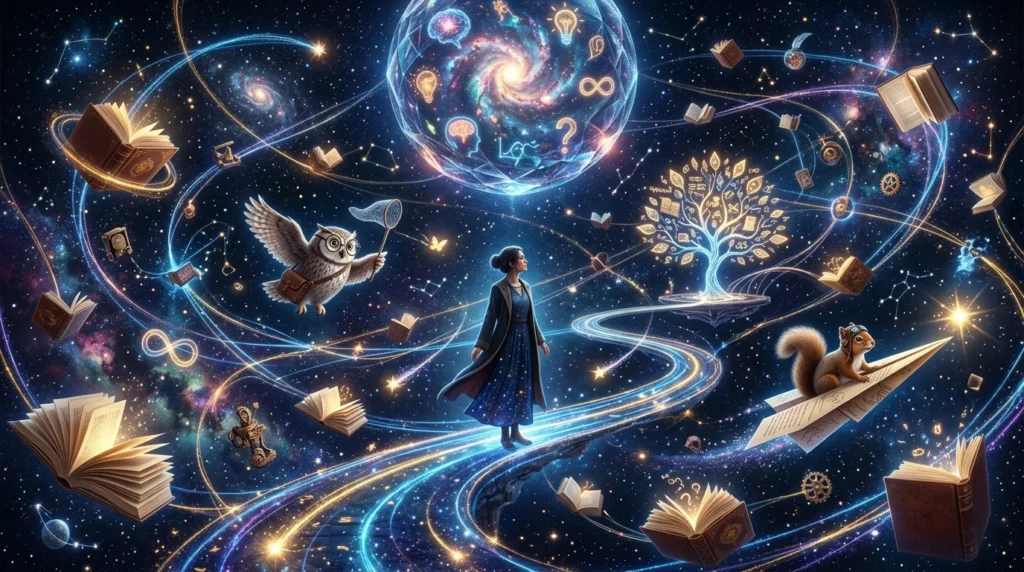
Have you ever stared at a blank page and struggled to describe what was happening inside a character’s mind? Maybe you wanted to show an idea forming, a memory returning, or a flood of emotions racing through someone’s head.
That is exactly why writers search for a metaphor for thought.
Thoughts are invisible. We cannot see them or touch them. Yet they shape every decision, dream, fear, and discovery. Metaphors help turn abstract thinking into something readers can picture and feel.
Instead of saying “she had many thoughts,” a writer might say, “her mind was a stormy sea.” Suddenly, the reader sees movement, chaos, and emotion.
Whether you’re writing a poem, a school essay, a novel, a social media caption, or simply exploring creative language, these metaphors can make your writing more vivid and memorable.
Let’s explore the fascinating world of thought through imagery, symbolism, and poetic expression.
What Is a Metaphor for Thought?
A metaphor for thought is a figure of speech that describes thinking by comparing it to something else without using “like” or “as.”
In simple terms, a metaphor turns an invisible mental process into a picture readers can imagine.
Writers use metaphors for thought because thoughts can be:
- Fast
- Slow
- Confused
- Brilliant
- Emotional
- Creative
- Dangerous
- Transformative
By connecting thoughts to familiar images, writers create stronger emotional imagery and deeper meaning.
Simple Examples
- My mind is a library.
- Her thoughts were a river.
- His brain was a crowded marketplace.
- My ideas are seeds waiting to grow.
- Their minds became battlegrounds.
Each metaphor creates a different feeling and image.
Quick List of Metaphor for Thought Examples
Here are quick, copy-and-paste examples:
- Thought is a river — ideas flow continuously.
- Thought is a garden — ideas grow over time.
- Thought is a storm — confusion and intensity.
- Thought is a flame — inspiration and creativity.
- Thought is a compass — guidance and direction.
- Thought is a mirror — reflection and self-awareness.
- Thought is a maze — complexity and uncertainty.
- Thought is a lighthouse — clarity and wisdom.
- Thought is a bird — freedom and imagination.
- Thought is a web — interconnected ideas.
- Thought is a mountain trail — careful exploration.
- Thought is a key — unlocking understanding.
- Thought is a telescope — seeing beyond the present.
- Thought is an ocean — vast and mysterious.
- Thought is a puzzle — problem-solving and discovery.
- Thought is a forest — rich and layered.
- Thought is a bridge — connecting concepts.
- Thought is a waterfall — unstoppable movement.
- Thought is a lantern — illumination.
- Thought is a clockwork machine — precision and logic.
- Thought is a battlefield — internal conflict.
- Thought is a cloud — uncertainty or dreaming.
- Thought is a map — navigation through life.
- Thought is a spark — sudden inspiration.
- Thought is a constellation — connected insights.
- Thought is a treasure chest — hidden knowledge.
- Thought is a wind — invisible but powerful.
- Thought is a tunnel — focused concentration.
- Thought is a current — subtle influence.
- Thought is a sunrise — awakening awareness.
Beautiful Metaphors for Thought
Thought Is a Garden
Ideas are planted, nurtured, and eventually bloom.
Example:
“Her thoughts were a garden filled with possibilities.”
This metaphor suggests growth, patience, and creativity.
Thought Is a River
Thoughts move continuously and often change direction.
Example:
“His thoughts flowed through his mind like an endless river.”
The image feels calm, natural, and alive.
Thought Is a Lighthouse
A single idea can guide us through uncertainty.
Example:
“In the darkness of doubt, her thoughts became a lighthouse.”
This metaphor symbolizes wisdom and guidance.
Thought Is a Constellation
Ideas connect across time and experience.
Example:
“His thoughts formed a constellation of memories and dreams.”
This creates beautiful visual language and symbolism.
Thought Is a Lantern
Thought illuminates what was once hidden.
Example:
“One clear thought became a lantern in the fog.”
Readers instantly understand the sense of discovery.
Poetic and Deep Thought Ideas
Poets often use rich symbolism when describing thought.
Thought Is an Ocean
The mind contains unexplored depths.
Example:
“Her thoughts drifted beneath the surface of an endless ocean.”
Thought Is a Secret Door
Ideas open pathways to new worlds.
Example:
“Every thought was a secret door waiting to be opened.”
Thought Is a Wandering Star
Thoughts guide us while remaining distant and mysterious.
Example:
“My thoughts were wandering stars across a midnight sky.”
Thought Is a Sleeping Volcano
Hidden ideas may suddenly erupt.
Example:
“His thoughts rested quietly like a sleeping volcano.”
Thought Is a Cathedral
The mind can hold awe, wonder, and complexity.
Example:
“Her thoughts rose like a cathedral built from questions.”
Metaphor for Thought in Creative Writing
Thought metaphors are powerful tools in storytelling and descriptive writing.
In Stories
Writers reveal emotions indirectly.
Example:
“Fear turned his thoughts into a cage.”
The reader feels restriction without being told directly.
In Poetry
Metaphors create emotional depth.
Example:
“My thoughts are autumn leaves,
spinning through the wind.”
In School Assignments
Creative metaphors make essays more memorable.
Example:
“Thought is the engine that drives human progress.”
In Personal Writing
Metaphors add personality and emotion.
Example:
“My thoughts became fireworks the moment I heard the news.”
Metaphor vs Simile
| Feature | Metaphor | Simile |
|---|---|---|
| Meaning | Direct comparison | Comparison using “like” or “as” |
| Grammar | Says something is something else | Says something is like something |
| Emotional Impact | Stronger and more immediate | Softer and more descriptive |
| Example | Thought is a river | Thought is like a river |
| Example | My mind is a maze | My mind is like a maze |
| Common Mistake | Forgetting it’s a direct comparison | Using “like” and calling it a metaphor |
Why People Confuse Metaphors and Similes
This is where many beginners get confused.
Both metaphors and similes compare things.
The difference is simple:
Metaphor
Direct comparison.
Thought is a storm.
Simile
Comparison using “like” or “as.”
Thought is like a storm.
Because both create imagery, students often mix them up.
A quick trick:
If you see like or as, it is usually a simile.
Real-Life Conversation Examples
School Discussion
Student: “I can’t organize my ideas.”
Teacher: “Think of your thoughts as a map. Follow one path at a time.”
🎯 Lesson: Metaphors make abstract ideas easier to understand.
Poetry Class
Student: “How can I describe thinking?”
Teacher: “Imagine your thoughts are birds flying across the sky.”
🎯 Lesson: Nature imagery creates vivid poetic language.
Storytelling Workshop
Writer: “My character feels confused.”
Mentor: “Turn their thoughts into a maze.”
🎯 Lesson: Metaphors reveal emotions indirectly.
Social Media Caption
Friend: “What should I write?”
Friend 2: “My thoughts are fireworks tonight.”
🎯 Lesson: Short metaphors can be powerful.
Classroom Essay
Student: “How do I sound more creative?”
Teacher: “Treat your thoughts as seeds of future ideas.”
🎯 Lesson: Symbolism strengthens writing.
How to Create Your Own Metaphor for Thought
Here’s the simple trick.
Think about what thoughts feel like.
Then ask:
- Do they move?
- Do they grow?
- Do they guide?
- Do they confuse?
- Do they inspire?
Next, find an object or image with the same qualities.
Visualization Method
Thoughts feel busy.
Busy things include:
- Beehives
- Cities
- Rivers
- Storms
Possible metaphor:
My thoughts were a bustling city.
Emotional Association Method
Thoughts feel hopeful.
Hopeful things include:
- Sunrises
- Seeds
- Stars
- Lanterns
Possible metaphor:
Her thoughts were a sunrise after a long night.
Symbolism Method
Thoughts reveal truth.
Symbols of truth include:
- Mirrors
- Light
- Keys
- Windows
Possible metaphor:
His thoughts became a key to understanding himself.
Common Mistakes Beginners Make
Using Similes Instead of Metaphors
❌ Thought is like a river.
✅ Thought is a river.
Why it happens:
Many beginners automatically use “like.”
Mixing Too Many Images
❌ My thoughts were a river, volcano, spaceship, and forest.
✅ My thoughts were a river carrying memories downstream.
Why it happens:
Writers get excited and combine too many metaphors.
Using Clichés
❌ Thoughts are food for the soul.
✅ Thoughts are lanterns in the fog.
Why it happens:
Common phrases feel safe but less memorable.
Forgetting the Meaning
❌ Thought is a banana.
✅ Thought is a compass.
Why it happens:
Not every image supports the intended meaning.
Related Figurative Language Terms
Simile
A comparison using “like” or “as.”
Example:
“Thought is like a river.”
Imagery
Language that creates sensory pictures.
Example:
“Thoughts drifted like silver clouds.”
Personification
Giving human qualities to non-human things.
Example:
“My thoughts whispered all night.”
Symbolism
Using objects to represent ideas.
Example:
A lantern symbolizing wisdom.
Hyperbole
An intentional exaggeration.
Example:
“I had a million thoughts at once.”
Symbolism of Thought in Literature
Throughout literature, thought often symbolizes:
- Self-discovery
- Wisdom
- Identity
- Imagination
- Inner conflict
- Transformation
Many writers connect thought with nature because natural images feel timeless and universal.
Forests symbolize complexity.
Rivers symbolize movement.
Stars symbolize guidance.
Gardens symbolize growth.
These symbols help readers connect emotionally with ideas that cannot be physically seen.
Frequently Asked Questions
What is the best metaphor for thought?
A river is one of the most popular metaphors because thoughts constantly move and change direction.
What is a poetic metaphor for thought?
“Thought is a wandering star” creates beautiful imagery and symbolism.
What metaphor represents deep thinking?
An ocean often represents deep thinking because it suggests mystery, depth, and hidden knowledge.
What metaphor shows confused thinking?
A maze is a strong metaphor for confusion and uncertainty.
What metaphor symbolizes creative thinking?
A garden symbolizes creativity because ideas grow and develop over time.
Is thought a metaphor itself?
No. Thought is a concept. A metaphor compares thought to something more concrete and visual.
Can I use thought metaphors in essays?
Yes. Thought metaphors can make essays more engaging and memorable when used appropriately.
Why do writers use metaphors for thought?
They help readers visualize emotions, ideas, and mental processes more clearly.
Conclusion
Thoughts are among the most powerful forces in human life, yet they are invisible. That is why a strong metaphor for thought can transform ordinary writing into something memorable and emotionally rich. Whether you picture thought as a river, a garden, a lighthouse, a maze, or an ocean, each image reveals a different side of how the mind works.
As you write poems, stories, essays, or personal reflections, experiment with different metaphors and see which images feel most alive to you. The best metaphors are not always the most complicated ones. Often, they are the images that instantly spark understanding.
Keep observing the world around you. Inspiration for your next metaphor may already be waiting in a forest, a storm, a star-filled sky, or even a single flickering lantern. ✨