
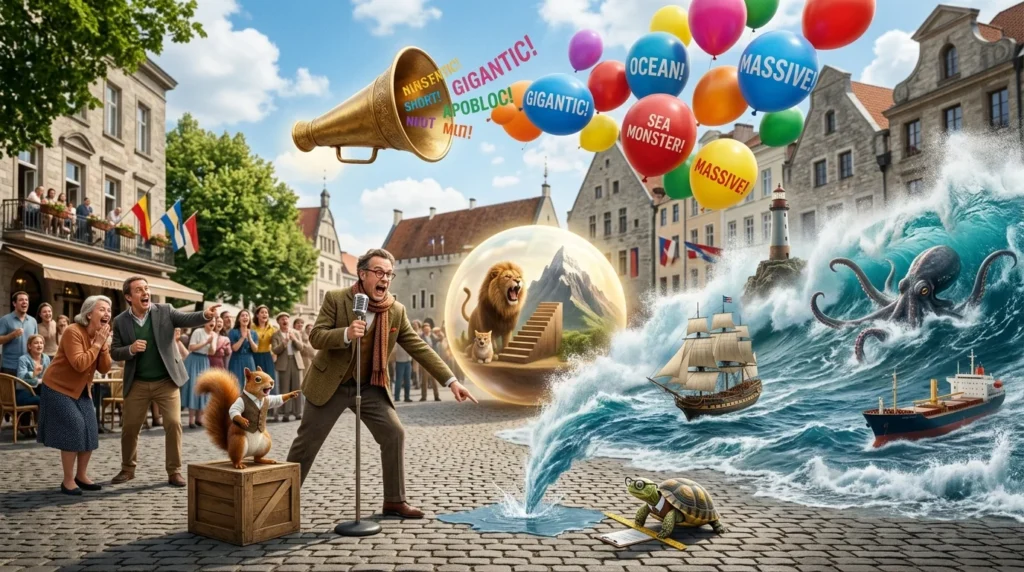
Have you ever written a story, poem, or school essay and wanted to describe someone who always makes things seem bigger, louder, or more dramatic than they really are?
That is often when writers start searching for a metaphor for exaggeration.
Maybe a character turns a small problem into a disaster. Maybe a friend tells stories that grow a little bigger every time they are repeated. Or perhaps you want a vivid image that captures the idea of stretching the truth without directly saying it.
This is where metaphors become useful.
A strong metaphor can transform a simple description into a memorable image. Instead of saying someone exaggerates, you can compare them to a magnifying glass, a carnival mirror, or a balloon that keeps expanding.
In creative writing, poetry, and everyday conversation, these images help readers instantly understand the feeling behind the words.
Let’s explore some of the most powerful metaphor ideas for exaggeration and learn how to use them naturally.
What Is a Metaphor for Exaggeration?
A metaphor for exaggeration is a figurative comparison that represents making something seem larger, more important, more dramatic, or more extreme than it really is.
In simple terms, it creates a picture that symbolizes overstatement.
Writers use these metaphors to:
- Add humor
- Build character personalities
- Create emotional imagery
- Strengthen storytelling
- Make descriptions more memorable
For example:
- His stories were balloons drifting farther from reality.
- Her worries were mountains built from pebbles.
These comparisons create stronger imagery than simply saying someone exaggerates.
Quick List of Metaphor for Exaggeration Examples
- A magnifying glass — making things appear bigger
- A balloon inflating endlessly — growing beyond reality
- A carnival mirror — distorting the truth
- A mountain made from pebbles — turning small things huge
- A wildfire of words — spreading drama quickly
- A thunderstorm in a teacup — excessive reaction
- A giant shadow — making something seem larger
- A microphone turned too high — amplifying everything
- A snowball rolling downhill — growing larger over time
- A megaphone for tiny whispers — overemphasizing details
- An overfilled suitcase — packed beyond necessity
- A dragon guarding a paperclip — treating small things as enormous
- A flood from a dripping faucet — overstating impact
- A skyscraper on a pebble foundation — inflated importance
- A firework for a candle flame — excessive display
- A giant wave in a puddle — making little things huge
- A stretched rubber band — extending beyond reality
- A soap bubble — bigger than its substance
- A roaring lion made of paper — impressive but inflated
- A cloud that blocks the sun — overwhelming perspective
Beautiful Metaphors for Exaggeration
These metaphors create vivid imagery while remaining easy to understand.
1. A Balloon Chasing the Sky
Exaggeration often starts small and keeps expanding.
Example:
His story was a balloon chasing the sky, growing larger with every retelling.
2. A Magnifying Glass Over Reality
This metaphor suggests making every detail seem bigger.
Example:
She viewed every inconvenience through a magnifying glass.
3. A Tiny Spark Wearing a Crown
A small event becomes the center of attention.
Example:
The mistake was a tiny spark wearing a crown.
4. A Wave Rising from a Raindrop
A small cause creates an oversized reaction.
Example:
His complaint became a wave rising from a raindrop.
5. A Shadow at Sunset
Shadows appear much larger than the object creating them.
Example:
The rumor was a sunset shadow stretching across the town.
Poetic and Deep Metaphor for Exaggeration Ideas
These examples work well in poetry and literary writing.
The Echo in an Empty Valley
An echo repeats and amplifies a sound.
Meaning: Exaggeration can make something seem larger through repetition.
A Crown Made of Smoke
Smoke looks impressive but disappears quickly.
Meaning: Inflated importance without lasting substance.
A Storm Sewn from Threads
Tiny details woven into something enormous.
Meaning: Building drama from insignificant facts.
The Moon Reflected in a Puddle
The reflection looks grand despite its small source.
Meaning: Appearance larger than reality.
A Giant Built from Whispers
Many small details combine into a dramatic narrative.
Meaning: Minor facts transformed into major stories.
Metaphor for Exaggeration in Creative Writing
Writers often use metaphors to show exaggeration indirectly.
Storytelling Example
Instead of:
Tom exaggerated everything.
Try:
Tom carried a magnifying glass in his imagination, enlarging every event he touched.
Poetry Example
Her fears were mountains rising from grains of sand.
Descriptive Writing Example
The argument became a wildfire fed by dry leaves and dramatic words.
School Assignment Example
The rumor rolled through the hallway like a snowball gathering size and speed.
These examples create stronger imagery and emotional impact.
Metaphor vs Simile
| Feature | Metaphor | Simile |
|---|---|---|
| Meaning | Direct comparison | Comparison using “like” or “as” |
| Grammar | Says something is something else | Says something is like something else |
| Emotional Impact | Stronger and more immediate | Slightly softer |
| Example | Her worry was a mountain. | Her worry was like a mountain. |
| Example | His story was a balloon. | His story was like a balloon. |
| Beginner Mistake | Taking comparison literally | Overusing “like” repeatedly |
Why People Confuse Metaphors and Similes
This is where many beginners get confused.
Both metaphors and similes compare two things.
The difference is simple:
Metaphor:
The rumor was a wildfire.
Simile:
The rumor spread like a wildfire.
A metaphor makes a direct statement.
A simile uses words such as like or as.
Because both create imagery and figurative language, students often mix them up.
Real-Life Conversation Examples
School
Student: “The homework was impossible!”
Friend: “Really?”
Student: “Okay, maybe not impossible. It just felt like a mountain.”
🎯 Lesson: Metaphors can express exaggerated feelings.
Classroom
Teacher: “Was the test truly a nightmare?”
Student: “Not exactly. It was just a storm cloud hanging over my week.”
🎯 Lesson: Metaphors soften exaggeration with imagery.
Poetry Writing
Writer: “I need a stronger image.”
Friend: “Try saying the problem became a wildfire instead of saying it got bigger.”
🎯 Lesson: Visual language creates emotional impact.
Social Media Caption
Person: “My inbox is an ocean today.”
Friend: “That definitely sounds more dramatic than saying you have lots of emails.”
🎯 Lesson: Metaphors make ordinary statements memorable.
Storytelling
Reader: “Why does the character seem dramatic?”
Writer: “Because every inconvenience becomes a mountain in her mind.”
🎯 Lesson: Metaphors reveal personality.
How to Create Your Own Metaphor for Exaggeration
Here’s the simple trick.
Think about things that naturally become larger, louder, or more distorted.
Method 1: Think Bigger
Start with something small.
Then imagine it becoming huge.
Example:
- Pebble → Mountain
- Whisper → Thunder
- Spark → Wildfire
Method 2: Use Distortion
Think about objects that change appearances.
Examples:
- Carnival mirror
- Magnifying glass
- Echo chamber
Method 3: Use Nature Symbolism
Nature offers endless metaphor ideas.
Examples:
- Snowball
- Avalanche
- Flood
- Storm
Method 4: Connect to Emotion
Ask yourself:
“What does exaggeration feel like?”
Possible answers:
- A balloon expanding
- A drum beating too loudly
- A shadow stretching endlessly
That emotional association often creates the strongest metaphors.
Common Mistakes Beginners Make
Using Clichés Too Often
Mistake:
Making a mountain out of a molehill.
Why it happens:
It’s familiar.
Better version:
Building a castle from a grain of sand.
Mixing Images
Mistake:
His story was a wildfire sailing through the ocean.
Why it happens:
Too many unrelated images.
Better version:
His story was a wildfire racing through dry grass.
Overexplaining
Mistake:
Explaining every detail after the metaphor.
Why it happens:
Fear that readers won’t understand.
Better version:
Trust the image.
Choosing Weak Comparisons
Mistake:
Comparing exaggeration to something that doesn’t grow or distort.
Better version:
Use symbols of expansion, amplification, or distortion.
Related Figurative Language Terms
Simile
A comparison using like or as.
Example:
The story grew like a snowball.
Imagery
Language that creates sensory pictures.
Example:
The rumor thundered through the hallway.
Personification
Giving human traits to nonhuman things.
Example:
The rumor raced through town.
Symbolism
Using objects or images to represent ideas.
Example:
A balloon symbolizes expansion.
Hyperbole
A deliberate exaggeration for effect.
Example:
I’ve told you a million times.
Symbolism of Exaggeration in Literature
Throughout literature, exaggeration often symbolizes fear, pride, insecurity, imagination, or emotional intensity.
Many authors show characters enlarging problems because emotions distort perspective.
A tiny concern becomes a mountain.
A rumor becomes a storm.
A mistake becomes a catastrophe.
These symbols help readers understand how people experience emotions rather than how events actually happen.
Frequently Asked Questions
What is the best metaphor for exaggeration?
A magnifying glass is one of the best metaphors because it makes things appear larger than they really are.
What symbolizes exaggeration?
Common symbols include balloons, mountains, megaphones, wildfire, snowballs, and carnival mirrors.
Is exaggeration a metaphor?
No. Exaggeration is usually called hyperbole. A metaphor is a comparison. However, metaphors can represent exaggeration.
What is a poetic metaphor for exaggeration?
A storm sewn from threads is a poetic metaphor showing something enormous created from something tiny.
Can exaggeration be used in creative writing?
Yes. Writers use exaggeration and metaphor together to create stronger imagery and emotional impact.
What is a simple metaphor for exaggeration?
Her worries were mountains.
This is easy to understand and creates a strong visual image.
How do I create my own metaphor?
Think of something that grows, expands, amplifies, or distorts reality, then connect it to the situation you are describing.
Conclusion
Finding the right metaphor for exaggeration is really about finding an image that shows something becoming larger than life. A balloon drifting upward, a magnifying glass enlarging details, or a mountain built from pebbles can all transform a plain sentence into something memorable.
The best metaphors do more than decorate writing. They help readers feel emotion, see imagery, and understand meaning instantly. As you practice creative writing, poetry, and descriptive language, start looking for everyday objects that symbolize growth, distortion, or amplification.
You may be surprised how quickly ordinary observations turn into powerful metaphors. Once you begin seeing the world through figurative language, inspiration appears almost everywhere.