
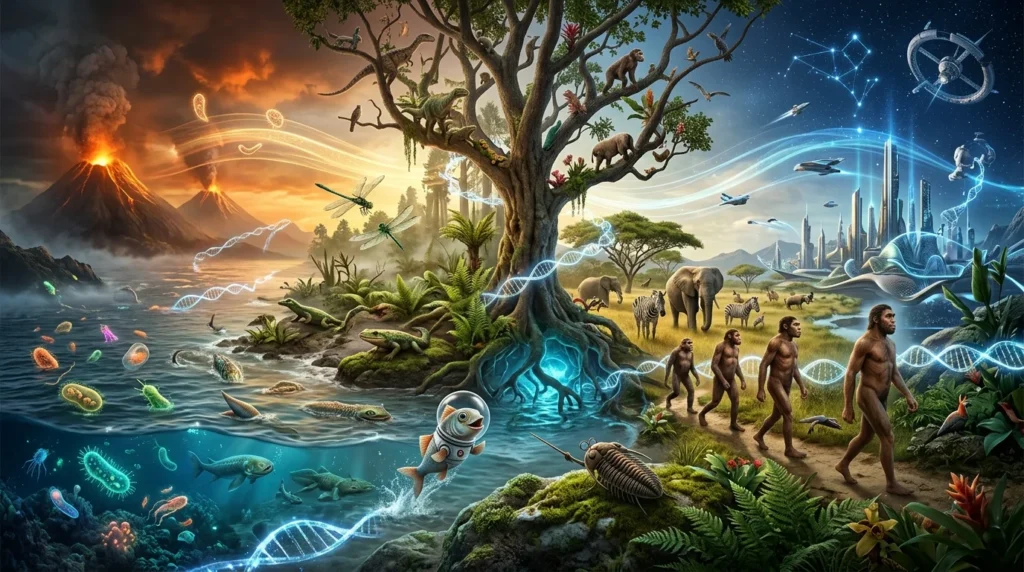
Have you ever tried to explain how a person changes over time, but words feel too small? Maybe you wrote a story about growing up, learning, or becoming stronger, and you needed something more powerful than plain description. That’s where a metaphor for evolution becomes so useful in writing.
When people search for metaphor for evolution, they are usually trying to express change in a deeper, more emotional way. Not just scientific change—but personal growth, transformation, survival, and becoming something new. The confusion often comes from not knowing how to turn “change over time” into vivid, creative language.
Think about it this way: evolution is not just biology. In writing, it becomes a symbol of slow, powerful transformation—like a seed becoming a forest or silence becoming a voice. That emotional layer is what makes metaphors so strong in storytelling. And once you learn them, your writing starts to feel alive.
Let’s explore how writers turn evolution into beautiful, unforgettable imagery.
What Is a Metaphor for Evolution?
A metaphor for evolution is a figure of speech that describes growth or change by comparing it to something more vivid, symbolic, or emotional—without using “like” or “as.”
Simple definition (featured snippet):
A metaphor for evolution is a creative comparison that shows change or growth as something symbolic, like transformation, unfolding, or rebirth.
Writers use it to show how something develops over time—emotionally, mentally, physically, or spiritually.
Instead of saying:
- “She changed a lot over time.”
A metaphor says:
- “She was a caterpillar unfolding into light.”
This adds emotion, imagery, and depth.
Why writers use it:
- To show personal growth
- To describe emotional transformation
- To add poetic meaning
- To make abstract ideas visual
Evolution in writing is not only about science. It becomes a story of becoming.
Quick List of Metaphors for Evolution Examples
Here are easy, copy-paste-friendly ideas:
- A seed breaking through soil → growth from struggle
- A butterfly leaving its cocoon → transformation
- A river carving new paths → constant change
- A blacksmith forging iron → shaping identity
- A sunrise after a long night → new beginning
- A snake shedding skin → letting go of the past
- A book being rewritten → personal reinvention
- A cracked stone becoming sculpture → hidden potential revealed
- A fire turning wood into ash → complete transformation
- A tree stretching toward the sky → lifelong growth
- A software updating itself → self-improvement
- A storm clearing into calm → emotional healing
- A seed turning into a forest → slow expansion
- A blank page filling with stories → life experience building up
- A clock reshaping time → evolving perception
- A caterpillar learning to fly → radical change
- A mountain forming from dust → long-term evolution
- A child becoming a constellation → growth into identity
- A mirror learning new reflections → changing self-image
- A cave opening into light → awareness and awakening
Beautiful Metaphors for Evolution
Here’s where writing becomes more emotional.
- “Her mind was a garden rewriting itself every season.”
→ shows constant mental growth - “His life was a river that refused to stay the same shape twice.”
→ evolution as movement and unpredictability - “Their identity was clay, always being reshaped by invisible hands.”
→ external influence and internal change - “She was a book still writing its final chapters.”
→ ongoing evolution - “He carried yesterday like a seed, not a weight.”
→ past transforming into growth
That tiny shift turns simple change into emotional imagery.
Poetic and Deep Evolution Ideas
Writers often use evolution as symbolism for life itself.
- “The soul does not stay still; it learns to bloom in silence.”
- “We are not finished beings, only drafts of something greater.”
- “Time does not pass us—it sculpts us.”
- “Every mistake is a step in disguise.”
- “We evolve like stars—slow, burning, and brilliant.”
These ideas work well in poetry, essays, and reflective writing.
Metaphor for Evolution in Creative Writing
Writers use evolution metaphors to show:
- emotional growth
- character development
- transformation arcs in stories
- personal reflection in essays
Example in storytelling:
“By the end of the journey, she was no longer the girl who started it. She was something quieter, stronger—like a river that had learned where to flow.”
Example in poetry:
“I was not broken—
I was becoming.”
Example in school writing:
“His confidence evolved like a plant reaching for sunlight after years underground.”
Evolution metaphors help readers feel change, not just understand it.
Metaphor vs Simile
| Feature | Metaphor | Simile |
|---|---|---|
| Meaning | Direct comparison | Uses “like” or “as” |
| Strength | Strong, emotional | Gentle, clear |
| Example | “Life is a river” | “Life is like a river” |
| Impact | More poetic | More explanatory |
| Beginner mistake | Over-complicating meaning | Overusing simple comparisons |
Why People Confuse Metaphors and Similes
This is where many beginners get confused.
- School teaches both at the same time
- Both compare ideas
- Both use imagery
- Both feel similar in meaning
The key difference is simple:
- Metaphor = “is”
- Simile = “like/as”
That tiny change creates a stronger emotional image.
Real-Life Conversation Examples
Classroom Example
Student: “How do I describe growth in my essay?”
Teacher: “Try saying it is evolution, like a seed becoming a tree.”
🎯 Lesson: Simple images create strong writing.
Poetry Workshop
Writer 1: “My poem feels empty.”
Writer 2: “Turn change into evolution—make it a journey.”
🎯 Lesson: Metaphors give emotional depth.
Social Media Caption
“You’ve changed so much.”
“Not change—evolution.”
🎯 Lesson: One word can shift meaning.
Storytelling Moment
Friend: “You’re different now.”
Reply: “I’ve been evolving quietly.”
🎯 Lesson: Identity can be expressed poetically.
How to Create Your Own Metaphor for Evolution
Here’s a simple trick:
- Think of “change”
- Choose a natural process (seed, fire, river, sky)
- Connect emotion to it
- Remove explanation words
- Turn it into identity
Example:
Idea: “I changed over time”
Metaphor: “I became a forest growing in silence.”
That’s where writing becomes powerful.
Common Mistakes Beginners Make
- Using literal descriptions instead of imagery
- Making metaphors too complicated
- Mixing simile and metaphor rules
- Forcing symbolism without emotion
- Over-explaining instead of showing
Correct version:
- “I grew stronger over time.” ❌
- “I became iron shaped by fire.” ✔️
Related Figurative Language Terms
- Simile → comparison using like/as
- Imagery → language that creates pictures
- Personification → giving human traits to things
- Symbolism → using objects to represent ideas
- Hyperbole → extreme exaggeration
All of these help build stronger metaphors for evolution.
Frequently Asked Questions
What is a simple metaphor for evolution?
A simple metaphor for evolution is comparing change to nature, like a seed becoming a tree or a caterpillar becoming a butterfly.
Why do writers use evolution metaphors?
They help show emotional or personal growth in a vivid and creative way.
Is evolution only a science metaphor?
No, in writing it often means personal or emotional transformation.
What is a poetic metaphor for evolution?
“Time is a sculptor shaping silent lives.”
How do I write a metaphor for change?
Choose something natural, connect emotion to it, and express transformation symbolically.
What is the difference between evolution and change in writing?
Change is simple; evolution implies deep, slow, meaningful transformation.
Optional Literary Insight
In literature, evolution is often used to show a character’s “becoming.” In many classic stories, heroes don’t just change—they evolve through struggle, loss, and discovery. Writers use nature, seasons, and animals to reflect this transformation because it feels universal and timeless.
Conclusion
A metaphor for evolution is more than a writing trick—it’s a way to show life becoming something new. Whether it’s a seed turning into a forest or a person rewriting their identity, these images help readers feel transformation deeply.
When you start using evolution metaphors, your writing stops being flat. It starts breathing, growing, and shifting like life itself. And that’s the real power of figurative language—it turns simple ideas into living stories.