
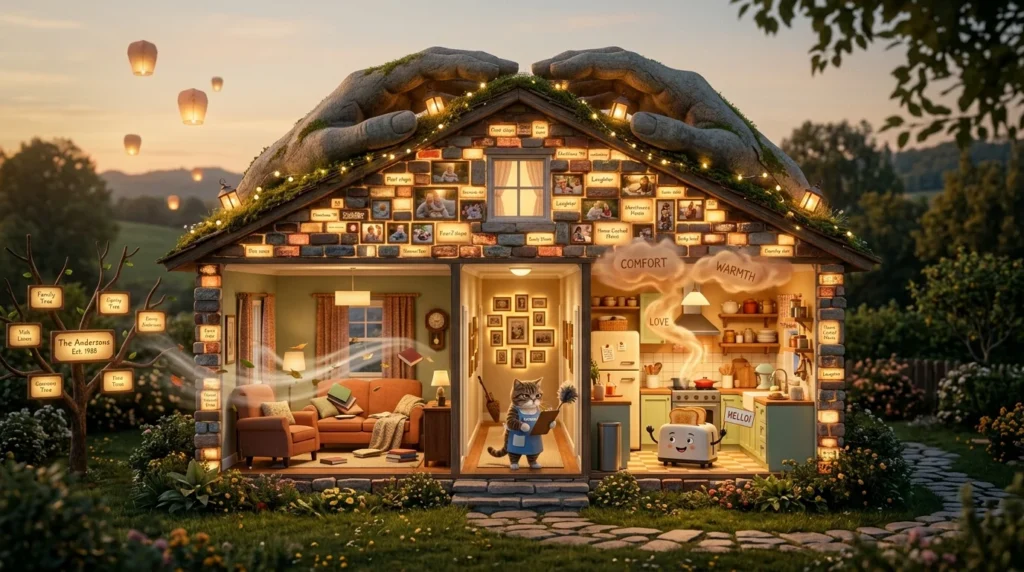
When someone says, “My house feels like a fortress,” they are not talking about bricks or stone in a literal way. They are using a metaphor for a house to show emotion, safety, or even loneliness inside a home. That’s the magic of figurative language—it turns simple spaces into living feelings.
Many students and new writers search for metaphor for a house because they want to make their writing more powerful. But often, they get stuck. Should a house be a heart? A cage? A ship? A memory?
Here’s the simple truth: a house is never just a building in writing. It becomes a symbol of everything happening inside a person’s life.
Think about it this way… a house can hold love, silence, chaos, or dreams. And each feeling can change the way we describe it.
Let’s explore how writers turn ordinary homes into unforgettable images.
What Is a Metaphor for a House?
A metaphor for a house is a figurative comparison where a house is described as something else to express emotion, identity, or meaning.
Simple definition (featured snippet):
A metaphor for a house is when a house is described as another thing to show feelings, personality, or life inside it.
Writers use this because a house is not just physical—it reflects human experience.
For example:
- “The house was a sleeping giant.”
- “Her home was a warm hug after a long day.”
Here, the house is not real giant or hug—but it feels like it emotionally.
Why writers love house metaphors:
- They show emotion quickly
- They create strong mental images
- They help readers feel “inside” the story
- They turn simple settings into symbolism
A house can represent family, memory, safety, isolation, or identity depending on how you shape it.
Quick List of Metaphor for a House Examples
Here are easy, copy-paste friendly examples:
- The house was a fortress – strong and protective
- The house was a memory box – full of past moments
- The house was a heartbeat – alive with family energy
- The house was a silent museum – full of still memories
- The house was a broken dream – once hopeful, now faded
- The house was a warm blanket – comforting and safe
- The house was a prison – trapped and heavy feeling
- The house was a storybook – each room held a tale
- The house was a ship in stormy seas – unstable life inside
- The house was a shell – empty without life
- The house was a garden of voices – full of people and noise
- The house was a shadow – dark and quiet
- The house was a beating drum – loud with daily life
- The house was a locked secret – hiding emotions inside
- The house was a warm fire – glowing with love
- The house was a fading photograph – losing its past
- The house was a stone heart – cold and unfeeling
- The house was a soft lullaby – peaceful and calming
- The house was a maze of memories – complex and emotional
- The house was a tree with deep roots – family connection
- The house was a storm shelter – protection in chaos
- The house was a stage – life constantly performing
- The house was a puzzle – every room a missing piece
- The house was a candle in the dark – small but hopeful
- The house was a closed book – secrets inside
Beautiful Metaphors for House
Some metaphors feel more emotional and poetic. These are often used in stories and poems.
- “The house was a heartbeat stitched into walls.”
→ Shows life and emotional presence inside home. - “The house stood like a tired guardian at the edge of memory.”
→ Suggests age, protection, and nostalgia. - “Every room was a whisper of who we used to be.”
→ Focuses on memory and identity. - “The house breathed slowly through its broken windows.”
→ Creates a living, almost human feeling.
That tiny change—making a house feel alive—creates stronger emotional impact.
Poetic and Deep House Metaphor Ideas
Writers often use houses to represent life itself.
Here are deeper symbolic ideas:
- A house as the human mind (rooms = thoughts)
- A house as the heart (warm or broken emotions)
- A house as time itself (old rooms = past memories)
- A house as identity (what we show vs hide)
- A house as a soul (light, darkness, emptiness)
In poetry, a house is never just walls—it becomes a reflection of inner life.
Example:
“The house kept my secrets like locked drawers in a forgotten chest.”
House Metaphors in Creative Writing
Here’s how writers actually use them:
1. Storytelling
- Builds mood quickly
- Shows character emotion through setting
Example:
“The house was a tired old man, sighing in every creak of wood.”
2. Poetry
- Adds symbolism
- Creates emotional depth
Example:
“My house is a candle, melting into silence.”
3. Descriptive Writing
- Makes essays more vivid
- Improves imagination score in school writing
Example:
“The house felt like a warm memory wrapped around us.”
4. Social Media Captions
- Short emotional impact
Examples:
- “Home is my quiet universe.”
- “This house holds my whole story.”
Metaphor vs Simile
| Feature | Metaphor | Simile |
|---|---|---|
| Meaning | Direct comparison | Uses “like” or “as” |
| Example | The house is a fortress | The house is like a fortress |
| Impact | Stronger, deeper | Softer, clearer |
| Emotion | More intense | More descriptive |
| Beginner mistake | Mixing literal meaning | Overusing “like” |
Why People Confuse Metaphors and Similes
This is where many beginners get stuck.
Here’s the simple reason:
- Both compare things
- Both use imagination
- Both describe feelings
But the structure is different.
A metaphor says:
“The house is a cage.”
A simile says:
“The house is like a cage.”
That tiny word “like” changes everything.
Real-Life Conversation Examples
🏠 School Classroom
Teacher: “Describe your house in one metaphor.”
Student: “My house is a warm blanket.”
Teacher: “Good—it shows comfort and safety.”
🎯 Lesson: Metaphors show feeling, not facts.
✍️ Poetry Writing
Student: “My house is a memory box.”
Friend: “That feels nostalgic and emotional.”
🎯 Lesson: Objects can hold emotions.
📱 Social Media Caption
User: “My house is my recharge station after chaos.”
Comment: “That’s so real.”
🎯 Lesson: Modern metaphors connect daily life.
📖 Storytelling
Writer: “The house was a silent museum of forgotten voices.”
🎯 Lesson: Houses can carry history.
How to Create Your Own House Metaphor
Here’s a simple trick:
- Think of a feeling (safe, lonely, happy)
- Think of an object (cage, garden, ship)
- Match emotion with image
Example:
- Feeling: comfort
- Object: blanket
- Metaphor: “The house is a blanket.”
You can also ask:
- Does my house feel alive or empty?
- Does it protect or trap?
- Does it remember or forget?
This is where creativity starts.
Common Mistakes Beginners Make
- Saying literal descriptions instead of metaphors
- Using too many metaphors in one sentence
- Mixing similes and metaphors incorrectly
- Choosing random objects with no emotional link
- Overcomplicating simple ideas
Correct example:
✔ “The house was a quiet memory.”
Incorrect example:
✘ “The house is like a big building with rooms.”
Related Figurative Language Terms
- Simile → comparison using like/as
- Imagery → words that create pictures in the mind
- Personification → giving human traits to objects
- Symbolism → using objects to represent ideas
- Hyperbole → extreme exaggeration
Frequently Asked Questions
What is a simple metaphor for a house?
A house can be called a “fortress” to show safety and protection.
Why do writers use house metaphors?
They help express emotion, memory, and identity in creative writing.
Is “home is a heart” a metaphor?
Yes, it shows emotional warmth and connection.
What does “house as a cage” mean?
It means feeling trapped or emotionally restricted.
Can students use house metaphors in essays?
Yes, they make writing more vivid and creative.
What is the difference between home and house metaphors?
House focuses on structure, home focuses on emotion.
Is “house is like a garden” a metaphor?
No, that is a simile because it uses “like.”
Conclusion
A metaphor for a house is more than just a writing trick—it is a way to show what life feels like inside walls. A house can become a heart, a memory, a cage, or even a dream depending on the story you want to tell.
When you start thinking this way, your writing changes. Ordinary rooms become emotional landscapes. Simple spaces start speaking.
So next time you describe a house, don’t just draw walls. Let it breathe. Let it feel. Let it tell a story only you can see.