
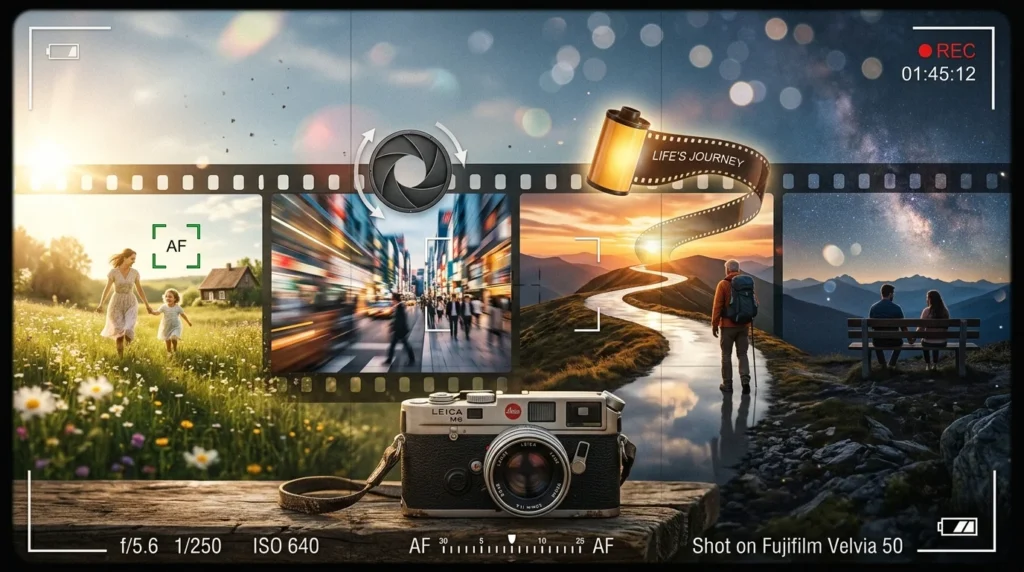
Have you ever looked at an old photo and suddenly remembered a moment you thought you had forgotten? That small feeling is where the camera metaphor for life begins to make sense. People often search for this idea when they are trying to understand life in a deeper, more emotional way, or when they need inspiration for writing, school essays, or poetry.
This metaphor compares life to a camera. At first, it might sound simple, but it carries a powerful message: every moment is being “captured,” whether we notice it or not. Some memories are clear like sharp photos, while others fade like old film.
Many beginners feel confused about how life can be compared to a machine. But here’s the simple trick… metaphors are not about logic—they are about feeling and imagination.
Think about it this way: life doesn’t literally take pictures, but our mind does. And that’s where the beauty begins.
Let’s explore this idea step by step and see how writers use it to create emotional, poetic meaning.
What Is the Camera Metaphor for Life?
The camera metaphor for life is a figurative idea that compares life to a camera that captures moments, memories, and experiences.
Simple definition (featured snippet style):
Life is like a camera because it captures every moment, stores memories, and shows us how we see the world.
Writers use this metaphor in figurative language to explain memory, time, and emotions in a visual way. Instead of saying “we remember life,” they say “life takes pictures.”
Why writers use it:
- To show how memories are stored
- To explain time passing
- To describe emotional moments
- To make writing more visual and poetic
Real-world meaning:
- A happy moment = a bright photo
- A sad memory = a blurry picture
- A life decision = choosing what to “capture”
Emotional impact:
This metaphor reminds us that every moment matters, because once it passes, it becomes part of our mental photo album.
Quick List of Camera Metaphor for Life Examples
Here are easy, copy-paste examples you can use in school, captions, or poetry:
- Life is a camera capturing every heartbeat.
- My memories are photos stored in my mind.
- Every moment is a snapshot I can’t retake.
- Time clicks like a camera shutter.
- My childhood is an old album full of faded pictures.
- Happiness is a bright flash in a dark room.
- Pain is a blurry image I try to refocus.
- Life zooms in on what matters most.
- The heart is a camera lens of emotions.
- Dreams are pictures not yet developed.
- Every goodbye is a photo I keep forever.
- The mind develops memories like film.
- Love is a picture taken in perfect light.
- Mistakes are overexposed memories.
- Hope is a camera that never stops clicking forward.
- Life frames moments we don’t notice at first.
- Silence is a photo without sound.
- The future is an undeveloped roll of film.
- Fear is a shaky, unfocused image.
- Joy is a picture you want to print twice.
Beautiful Metaphors for Camera Metaphor for Life
Here are deeper, more emotional versions of the idea:
- Life is a camera that never deletes its pictures.
- The soul is a lens that decides how the world looks.
- Memory is a darkroom where life develops slowly.
- Time is a photographer who never stops clicking.
- The heart stores images no one else can see.
Each one adds emotional depth and symbolic meaning. Writers use this to show that life is not just lived—it is remembered.
Poetic and Deep Camera Metaphor for Life Ideas
Here’s where the metaphor becomes artistic:
- In the album of time, every page breathes.
- Life clicks once, but echoes forever.
- We are both the photographer and the picture.
- Some moments refuse to fade, like ink on light.
- The lens of memory never blinks.
These lines feel almost like poetry because they mix imagery, symbolism, and emotional language.
Camera Metaphor for Life in Creative Writing
Writers use this metaphor in many ways:
In storytelling:
A character might “look back at the photo of their past life” to show regret or nostalgia.
In poetry:
Poets use camera images to show time passing.
In descriptive writing:
It helps readers see emotions instead of just reading them.
School example:
“My life is a camera, and every day I take silent pictures of joy and struggle.”
Mini writing example:
I walk through my day like a photographer in a quiet city. Every smile, every tear, every shadow becomes part of my invisible album.
Metaphor vs Simile
| Feature | Metaphor | Simile |
|---|---|---|
| Meaning | Direct comparison | Comparison using “like” or “as” |
| Grammar | Life is a camera | Life is like a camera |
| Emotional impact | Strong and deep | Softer and clearer |
| Example | Life is a camera | Life is like a camera |
| Beginner mistake | Confusing literal meaning | Overusing “like/as” |
Why People Confuse Metaphors and Similes
This is where many beginners get stuck.
- They think both mean the same thing
- School books mix examples
- Sentence structure feels similar
- Both compare life to objects
But here’s the simple difference:
A metaphor says it is, while a simile says it is like.
Real-Life Conversation Examples
1. Classroom discussion
Teacher: “What is life like in your opinion?”
Student: “Life is a camera. It captures everything we feel.”
🎯 Lesson: Metaphors help express deep thoughts simply.
2. Poetry writing
Student A: “I wrote life is like a camera.”
Student B: “Try saying life is a camera. It sounds stronger.”
🎯 Lesson: Small changes make writing more powerful.
3. Social media caption
“Life is a camera—smile for the memory.”
🎯 Lesson: Metaphors work great in short captions.
4. Storytelling moment
He paused and said, “My childhood is just a faded photo now.”
🎯 Lesson: Metaphors show emotion without explanation.
How to Create Your Own Camera Metaphor for Life
Try this simple method:
- Think of life moments (happy, sad, confused)
- Match them with camera features
- Turn feelings into images
Example process:
- Memory → photo album
- Time → shutter click
- Emotion → lighting
Now build:
“Life is a camera that…”
Keep it personal. That’s the secret.
Common Mistakes Beginners Make
- Using too many words → makes the metaphor weak
- Making it too literal → loses emotion
- Copying examples without understanding
- Mixing simile and metaphor incorrectly
- Overcomplicating simple ideas
Correct version is always simple:
✔ Life is a camera capturing moments
Related Figurative Language Terms
- Simile: comparison using like/as
- Imagery: language that creates pictures in the mind
- Personification: giving human traits to objects
- Symbolism: using objects to represent ideas
- Hyperbole: extreme exaggeration
Frequently Asked Questions
What does the camera metaphor for life mean?
It means life is compared to a camera that captures memories and moments.
Why do writers use the camera metaphor?
To show memory, emotion, and time in a visual and creative way.
Is “life is a camera” a metaphor or simile?
It is a metaphor because it directly says life is a camera.
How do I use this metaphor in a sentence?
Example: Life is a camera capturing every moment I forget to notice.
Can I use it in school essays?
Yes, it is perfect for creative writing and descriptive essays.
What emotions does this metaphor show?
It shows nostalgia, memory, happiness, and reflection.
Optional Authority Insight
In modern poetry and storytelling, the camera metaphor became popular because photography itself changed how humans think about memory. Writers began to see life as a “recorded experience,” not just lived time. That’s why this metaphor feels so modern, even though the idea is simple.
Conclusion
The camera metaphor for life helps us see something beautiful: every moment matters, even the small ones we forget. Like a camera, life keeps capturing everything—joy, pain, silence, and change.
When you use this metaphor in writing, you are not just describing life. You are showing it through images people can feel.
So next time you think about your day, imagine a camera quietly clicking in the background. Because in your own way, you are both the photographer and the memory being created.