
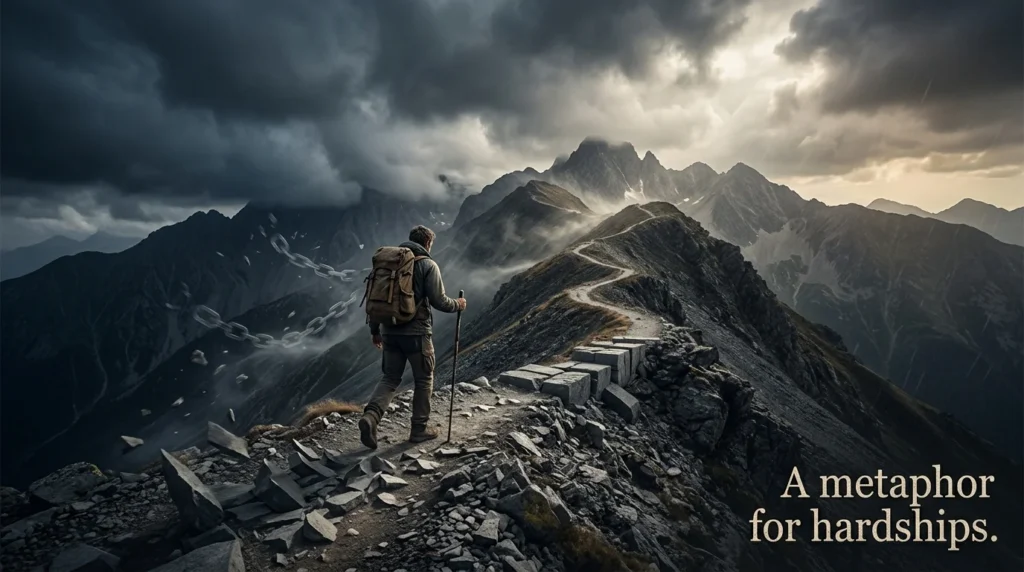
When life feels heavy, it is often hard to explain that feeling in plain words. You might say, “I’m going through a lot,” but that doesn’t really show the depth of it. This is where a metaphor for hardships becomes powerful in writing and speech.
Writers, poets, and students often search for metaphor for hardships when they want to express pain, struggle, or emotional pressure in a more creative and meaningful way. Maybe they are writing a poem, a school essay, or even a personal journal. The challenge is always the same: how do you turn invisible feelings into visible images?
Here’s the simple truth—metaphors help us see emotions instead of just naming them.
Think about it this way: instead of saying “life is difficult,” you can say “life is a steep mountain with no end in sight.” Suddenly, the feeling becomes real, visual, and emotional. And that is the magic we are going to explore together.
What Is a Metaphor for Hardships?
A metaphor for hardships is a figurative expression that compares life struggles to something else—without using “like” or “as.”
Featured snippet definition:
A metaphor for hardships is a figurative comparison that describes life struggles as another image, object, or situation to express emotional difficulty more vividly.
Writers use this because emotions like pain, stress, or failure are hard to describe directly. Metaphors turn those feelings into pictures the reader can understand instantly.
For example:
- “Life is a storm” → struggles feel chaotic and overwhelming
- “My journey is a broken road” → progress is difficult and interrupted
This is where figurative language becomes powerful. It doesn’t just tell—it shows.
Hardship metaphors are common in:
- poetry
- storytelling
- motivational writing
- personal essays
- song lyrics
They create emotional imagery that stays in the reader’s mind.
Quick List of Metaphors for Hardships Examples
Here are simple, emotional, and copy-ready examples you can use:
- Life is a stormy sea — struggles come in waves
- My journey is a broken road — progress is full of obstacles
- Hard times are a heavy backpack — life feels exhausting
- Life is a dark tunnel — no clear end in sight
- My heart is a cracked glass — emotional pain is visible
- Struggles are burning fire — intense and overwhelming
- Life is a steep mountain — difficult to climb forward
- My dreams are locked doors — blocked by challenges
- Hardship is a winter night — cold, lonely, and long
- Life is a battlefield — constant emotional fighting
- My thoughts are tangled wires — confused and stuck
- Struggle is a sinking ship — losing control slowly
- Life is a maze with no exit — confusion and frustration
- Pain is a shadow that follows me — always present
- Hard times are thunderclouds — heavy and threatening
- My future is foggy glass — unclear and uncertain
- Life is a cracked bridge — unsafe but still crossed
- Struggles are chains on my feet — slowing me down
- My hope is a flickering candle — weak but alive
- Life is a broken compass — direction feels lost
Beautiful Metaphors for Hardships
Some metaphors are not just descriptive—they are deeply emotional.
- “Hardship is a winter that refuses to leave.”
→ Suggests long-lasting emotional coldness. - “My life is a painting washed away by rain.”
→ Dreams feel erased or ruined. - “Struggle is a silent earthquake inside me.”
→ Emotional damage that others cannot see. - “Hope is a small boat in a violent ocean.”
→ Fragile strength in difficulty. - “My soul is a cracked mirror reflecting pain.”
→ Inner emotional damage and broken identity.
That tiny change in wording creates stronger emotional impact.
Poetic and Deep Metaphors for Hardships Ideas
Here are more artistic and symbolic versions:
- “Life is ink bleeding through fragile paper.”
- “Hardship is a night that swallows stars.”
- “My journey is footsteps in burning sand.”
- “Struggle is a storm carving mountains inside me.”
- “Pain is music played in a broken room.”
These are often used in poetry because they carry symbolism and emotional depth.
Metaphor for Hardships in Creative Writing
Writers use hardship metaphors to:
- build emotional storytelling
- create vivid poetry
- enhance descriptive writing
- connect with readers deeply
Example in storytelling:
“The boy walked through life like a cracked bridge over a deep canyon, each step uncertain but necessary.”
Example in poetry:
“My days are storms that never learn to end,
And I am the sky trying to hold them in.”
School writing example:
“Hardships are like climbing a mountain; every step is difficult, but the view at the top is worth it.”
Metaphors make writing feel alive instead of flat.
Metaphor vs Simile
| Feature | Metaphor | Simile |
|---|---|---|
| Meaning | Direct comparison | Comparison using “like/as” |
| Structure | “Life is a storm” | “Life is like a storm” |
| Impact | Strong and emotional | Gentle and clear |
| Example | Hardship is a cage | Hardship is like a cage |
| Beginner mistake | Overusing vague images | Repeating “like” too much |
Why People Confuse Metaphors and Similes
This is where many beginners get confused.
- Both compare two things
- Both create imagery
- School lessons mix them early on
- Sentence structure looks similar
The simple trick is this:
If you see “like” or “as” → it is a simile
If you don’t → it is a metaphor
That small rule clears most confusion instantly.
Real-Life Conversation Examples
1. Classroom talk
Student: “My exams feel like a storm.”
Teacher: “Good simile. Now try a metaphor.”
Student: “My exams are a storm.”
🎯 Lesson: Metaphors remove comparison words.
2. Poetry group
Writer: “Life is a broken road.”
Friend: “That feels powerful.”
🎯 Lesson: Simple metaphors create strong emotions.
3. Social media caption
Post: “Hard days are heavy clouds over my mind.”
🎯 Lesson: Metaphors work great in short captions.
4. Story writing
Narrator: “His struggle was a locked door he kept pushing.”
🎯 Lesson: Metaphors build visual storytelling.
How to Create Your Own Metaphor for Hardships
Here’s the simple trick beginners can use:
- Think of the feeling (stress, pain, confusion)
- Imagine a physical object (storm, road, fire, cage)
- Connect emotion to image
- Keep it simple
Examples:
- Stress → “storm”
- Confusion → “maze”
- Pain → “broken glass”
- Hard work → “mountain climb”
That connection is where creativity begins.
Common Mistakes Beginners Make
- Using too many words → weakens imagery
- Choosing random objects → confuses meaning
- Making it too complex → loses emotional impact
- Mixing simile and metaphor → breaks clarity
- Over-explaining → kills poetic effect
Fix: Keep it simple, emotional, and visual.
Related Figurative Language Terms
- Simile → comparison using like/as
- Imagery → language that creates mental pictures
- Personification → giving human traits to objects
- Symbolism → using objects to represent ideas
- Hyperbole → exaggeration for effect
All of these help strengthen metaphors for hardships.
Frequently Asked Questions
What is a metaphor for hardships?
It is a figurative expression that compares struggles to something visual like storms, mountains, or broken roads.
Why do writers use hardship metaphors?
They make emotional experiences easier to understand and more powerful to read.
What is the best metaphor for life struggles?
Common ones include “life is a storm” or “life is a mountain climb.”
Can I use metaphors in essays?
Yes, especially in creative or descriptive writing sections.
What is the difference between hardship metaphor and simile?
Metaphors say “life is a storm,” while similes say “life is like a storm.”
Are metaphors used in poetry?
Yes, poetry relies heavily on metaphors for emotional depth.
How do I write a strong metaphor?
Connect an emotion to a strong visual image like nature, objects, or journeys.
Optional Insight: Why Hardship Metaphors Are So Powerful
Across literature, hardship is often shown through nature symbolism—storms, winters, deserts, and mountains. These images are universal, meaning everyone understands them without explanation.
That is why writers from poetry to novels rely on them. They turn invisible pain into visible meaning.
Conclusion
A metaphor for hardships is more than just a writing trick—it is a way of making emotions visible. Instead of saying life is difficult, you can show it as storms, broken roads, or endless mountains.
When you start using metaphors, your writing becomes more emotional, more creative, and more human. You stop telling feelings and start showing them.
And that is where real writing begins—not in perfection, but in imagination that feels alive.