
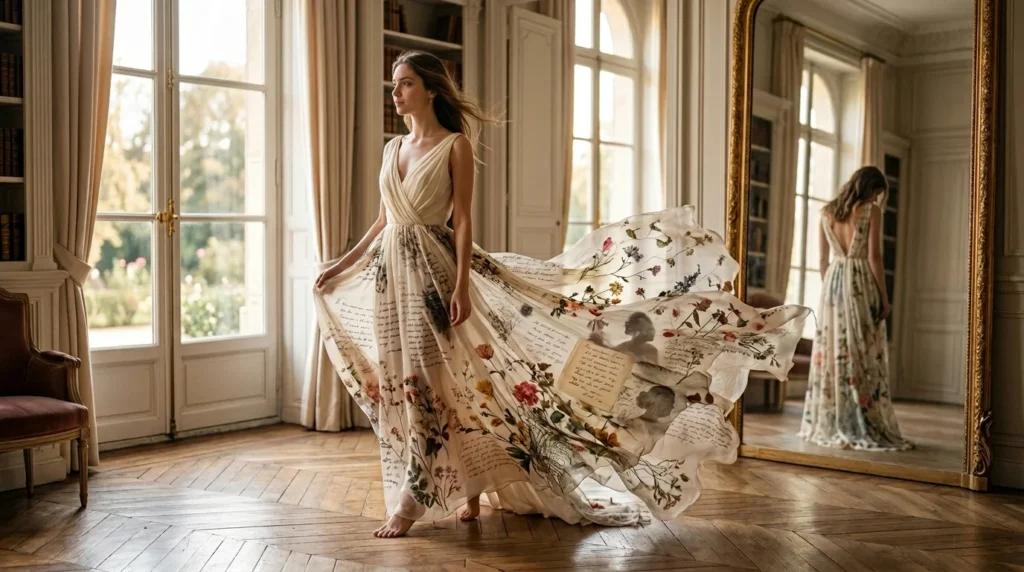
Sometimes you look at a dress and feel something more than fabric. It feels like a memory, a mood, or even a personality. That’s exactly why writers search for a metaphor for dress. They want to turn clothing into emotion, meaning, and storytelling.
In writing, a dress is never just a dress. It can become a river of silk, a soft sunset on skin, or even armor made of elegance. This is where language becomes art. And many beginners get confused about how to turn simple clothing into powerful imagery.
Here’s the simple truth: a dress becomes a metaphor when it represents something beyond itself—emotion, identity, freedom, beauty, or transformation.
Let’s explore how writers do this in the most natural and creative way.
What Is a Metaphor for Dress?
A metaphor for dress is a creative comparison where a dress is described as something else to show emotion, beauty, or meaning without using “like” or “as.”
Simple definition (featured snippet style):
A metaphor for dress is when a dress is described as something symbolic—such as nature, emotion, or an object—to create deeper meaning.
Writers use this because clothing carries identity. What we wear often reflects how we feel inside.
Think about it this way:
- A flowing dress can feel like freedom
- A tight dress can feel like control or structure
- A colorful dress can feel like joy or celebration
So the dress becomes a story, not just fabric.
In creative writing, metaphors for dress help create:
- emotional imagery
- symbolic meaning
- poetic expression
- visual storytelling
Quick List of Metaphors for Dress Examples
Here are easy, copy-paste-friendly examples:
- The dress was a river of silk (flowing elegance)
- Her dress was a sunset wrapped around her body (warm beauty)
- The dress became a soft whisper of fabric (gentle movement)
- It was a garden stitched in thread (floral design)
- Her dress looked like moonlight on water (soft glow)
- The gown was a cloud floating through the room (light and airy)
- It became a shield of elegance (confidence and strength)
- The dress was a storm of color (bold expression)
- It felt like a second skin of memories (emotional connection)
- Her dress was a painted sky at dusk (artistic beauty)
- The fabric was a silent poem in motion (poetic flow)
- It became a butterfly trapped in silk (fragile beauty)
- The dress was a frozen waterfall of satin (smooth shine)
- It looked like fire turned into fabric (intensity and passion)
- The gown was a dream stitched into reality (fantasy feeling)
- Her dress became a shadow of elegance (mysterious tone)
- It was a river of stars across her body (sparkling design)
- The dress felt like music you could see (rhythm and flow)
- It was a book written in fabric folds (storytelling symbolism)
- The dress was a soft cage of beauty (controlled elegance)
Beautiful Metaphors for Dress
Here’s where writing becomes more emotional.
- “A dress is a moving painting.” → art in motion
- “Her dress was a quiet storm.” → strong but graceful emotion
- “It was a memory stitched in silk.” → emotional nostalgia
- “The dress was liquid moonlight.” → soft glowing imagery
- “She wore a sunset that refused to fade.” → lasting beauty
Each one turns clothing into feeling. That’s the magic of metaphor.
Poetic and Deep Metaphor for Dress Ideas
Now let’s go deeper into literary style.
- The dress is a story that walks before the body speaks
- It is a silent language of fabric and emotion
- A dress becomes a mirror of the soul’s color
- It is a soft architecture of identity
- The dress is a poem that moves through space
Writers often use this style in:
- poetry
- novels
- fashion descriptions
- emotional storytelling
This is where symbolism and imagery become powerful tools.
Metaphor for Dress in Creative Writing
Writers use dress metaphors to:
- show personality without direct description
- create mood in scenes
- build emotional connection
- describe characters in stories
Example in storytelling:
“She entered the room, her dress a storm of gold and silence, turning heads without a word.”
That sentence does more than describe clothing—it tells us about confidence and presence.
Example in poetry:
“Your dress was a river,
and I was only the shore watching it pass.”
That’s emotional imagery in action.
Metaphor vs Simile
| Feature | Metaphor | Simile |
|---|---|---|
| Meaning | Direct comparison | Uses “like” or “as” |
| Example | The dress is a river | The dress is like a river |
| Impact | Stronger, deeper | Softer, clearer |
| Emotion | More poetic | More descriptive |
| Beginner mistake | Mixing both styles | Overusing “like” |
Why People Confuse Metaphors and Similes
This is where many beginners get stuck.
- School teaches both at the same time
- Sentences feel similar
- Both compare two things
- Writing rules get mixed up
Simple trick:
- If you see “like” or “as” → simile
- If you don’t → metaphor
That tiny rule clears most confusion.
Real-Life Conversation Examples
1. Classroom discussion
Teacher: “Describe her dress creatively.”
Student: “Her dress was a sunset walking through the room.”
🎯 Lesson: Creativity replaces plain description.
2. Poetry writing
Friend: “I can’t describe this gown.”
Writer: “Call it a river of silk.”
🎯 Lesson: Metaphors simplify imagination.
3. Social media caption
“She wore confidence like fabric.”
🎯 Lesson: Short metaphors work best online.
How to Create Your Own Metaphor for Dress
Here’s a simple trick:
- Look at the dress
- Think of its feeling (soft, bold, bright)
- Match it with nature or emotion
- Turn it into an image
Examples:
- soft → cloud, water, feather
- bright → sun, fire, stars
- elegant → moonlight, silk river
Now combine:
“A dress like moonlight on water.”
That’s your metaphor.
Common Mistakes Beginners Make
- Overcomplicating the sentence → keep it simple
- Mixing simile and metaphor → choose one style
- Using forced comparisons → let emotion guide you
- Repeating “beautiful” too often → show instead of telling
- Using unclear images → choose familiar visuals
Related Figurative Language Terms
- Simile → comparison using “like/as”
- Imagery → language that creates pictures in the mind
- Personification → giving human traits to objects
- Symbolism → using objects to represent ideas
- Hyperbole → exaggerated expression for effect
Frequently Asked Questions
1. What is a metaphor for dress?
It is a comparison where a dress is described as something symbolic like nature or emotion.
2. Can a dress be a metaphor in poetry?
Yes, it often represents identity, mood, or beauty.
3. What is a simple example?
“The dress was a river of silk.”
4. Why do writers use dress metaphors?
To create emotional and visual imagery.
5. Is “like a dress” a metaphor?
No, that is a simile.
6. What emotions can a dress metaphor show?
Beauty, freedom, elegance, mystery, or confidence.
7. How do I write my own dress metaphor?
Match the dress feeling with nature or emotion and combine them.
Optional Literary Insight
In literature, clothing often symbolizes identity. From royal gowns in classic novels to flowing dresses in modern poetry, fabric becomes a way to show power, innocence, or transformation. Writers use dresses not just for fashion—but for storytelling depth.
Conclusion
A metaphor for dress turns simple clothing into emotion, memory, and meaning. Instead of just describing fabric, you describe feeling. That’s what makes writing powerful.
When you start seeing dresses as rivers, sunsets, or songs, your writing becomes more alive. You don’t just describe—you paint with words. And that is the real beauty of figurative language.
Keep it simple, stay visual, and let emotion guide your metaphors.