
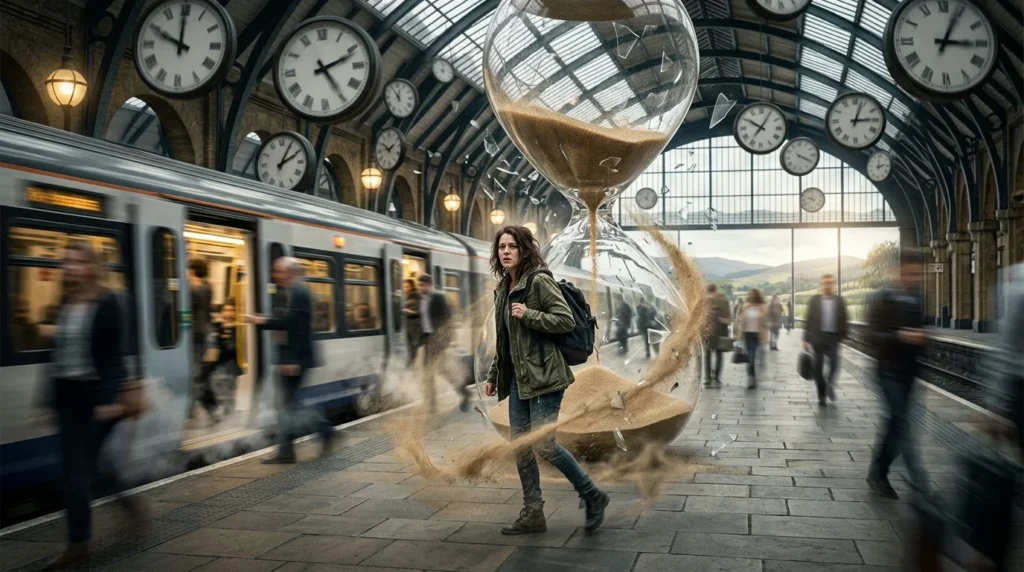
Have you ever sat waiting for a text message, watched the clock during the last few minutes of class, or counted down the days until something exciting happens? That restless feeling can be hard to describe. Many writers search for a metaphor for impatience because simple words like “eager” or “restless” don’t always capture the emotion fully.
A good metaphor turns a feeling into a picture. Instead of saying someone is impatient, you can compare their impatience to a racing horse, a boiling kettle, or a storm building in the distance. These images help readers feel the emotion instead of simply reading about it.
Whether you’re writing a poem, story, school assignment, social media caption, or creative journal entry, metaphors can make your writing more vivid and memorable.
Let’s explore some powerful ways to describe impatience through figurative language and poetic imagery.
What Is a Metaphor for Impatience?
A metaphor for impatience is a figurative comparison that describes impatience as something else without using the words “like” or “as.”
In creative writing, metaphors transform emotions into images readers can easily imagine.
For example:
- His impatience was a ticking time bomb.
- Her impatience was a horse pulling against its reins.
Writers use metaphors because they create stronger imagery, symbolism, and emotional impact than literal descriptions.
Think about it this way: instead of telling readers someone cannot wait, a metaphor shows exactly what that feeling looks and feels like.
Quick List of Metaphor for Impatience Examples
- A ticking time bomb — ready to explode
- A boiling kettle — building pressure
- A racehorse at the gate — eager to move
- A trapped lightning bolt — restless energy
- A drumbeat in the chest — constant anticipation
- A coiled spring — tension waiting to release
- A wildfire in dry grass — spreading urgency
- A caged bird — longing for freedom
- A speeding train — impossible to slow down
- A buzzing hive — nonstop activity
- A clock with broken hands — frustrating delay
- A river pushing against a dam — restrained force
- A storm gathering strength — growing tension
- A rocket on the launchpad — ready for action
- A shaking leaf in the wind — nervous anticipation
- A hungry wolf pacing — desperate waiting
- A balloon stretched tight — near bursting
- A candle burning at both ends — consuming urgency
- A spark searching for fuel — craving movement
- A drumroll before the reveal — suspenseful excitement
- A wave crashing toward shore — unstoppable momentum
- A lion pacing its cage — contained energy
- A racing heartbeat — eager expectation
- A furnace running hot — intense anticipation
- A loaded arrow — ready to fly
Beautiful Metaphors for Impatience
1. Impatience Was a Boiling Kettle
Pressure built with every passing second until it could no longer stay silent.
2. Impatience Was a Racehorse at the Starting Gate
Every muscle strained forward before the signal arrived.
3. Impatience Was a River Pressing Against a Dam
The urge to move kept growing behind an invisible barrier.
4. Impatience Was a Thundercloud
Energy gathered and swirled, waiting for release.
5. Impatience Was a Candle Burning Too Fast
Every moment consumed itself in anticipation.
6. Impatience Was a Caged Flame
It danced wildly, searching for room to grow.
Poetic and Deep Metaphor for Impatience Ideas
These metaphors add symbolism and emotional depth.
A Bird Beating Against the Sky
Represents a soul longing to reach its destination.
A Tide Pulling Toward the Moon
Suggests a force that cannot resist moving forward.
An Arrow Holding Its Breath
Captures suspended action and eager anticipation.
A Storm Behind Closed Curtains
Symbolizes hidden emotional energy waiting to emerge.
A Star Waiting for Nightfall
Represents hope mixed with longing.
Roots Searching for Rain
Suggests a deep need that cannot be ignored.
A Door Half Open
Symbolizes possibility that feels frustratingly close.
Metaphor for Impatience in Creative Writing
Writers often use metaphors to make emotional scenes feel alive.
Storytelling Example
Jacob’s impatience was a racehorse pawing at the dirt, desperate for the gate to open.
Poetry Example
My impatience is a river,
pressing endlessly against stone,
dreaming of the sea.
Descriptive Writing Example
The minutes crawled forward while her impatience burned like a furnace beneath calm words.
School Assignment Example
His impatience was a ticking clock echoing through his thoughts.
Most writers use metaphors because readers connect with images more quickly than explanations.
Metaphor vs Simile
| Feature | Metaphor | Simile |
|---|---|---|
| Meaning | Direct comparison | Comparison using like or as |
| Grammar | Says something is something else | Says something is like something else |
| Emotional Impact | Stronger and more direct | Softer and more obvious |
| Example | Impatience was a wildfire | Impatience was like a wildfire |
| Beginner Mistake | Forgetting it’s symbolic | Overusing like and as |
Why People Confuse Metaphors and Similes
This is where many beginners get confused.
Both metaphors and similes compare things.
The difference is simple:
Metaphor: Impatience was a storm.
Simile: Impatience was like a storm.
Many students learn both at the same time and focus only on the comparison rather than the sentence structure.
A quick trick:
- If you see like or as, it’s usually a simile.
- If you don’t, it’s often a metaphor.
Real-Life Conversation Examples
School Scenario
Student: I can’t wait for summer break.
Friend: You’re a racehorse waiting for the gate to open.
🎯 Lesson: Impatience becomes more vivid through imagery.
Classroom Scenario
Teacher: Why are you checking the clock every minute?
Student: My impatience is a ticking bomb today.
🎯 Lesson: Metaphors add emotion instantly.
Poetry Writing Scenario
Writer: I need a way to describe anticipation.
Friend: Try calling it a river pushing against a dam.
🎯 Lesson: Nature imagery creates stronger symbolism.
Social Media Caption
Caption: My impatience is a rocket on the launchpad.
🎯 Lesson: Short metaphors work well online.
Storytelling Scenario
Author: How should I describe his waiting?
Editor: Make his impatience a storm gathering strength.
🎯 Lesson: Metaphors create visual language.
How to Create Your Own Metaphor for Impatience
Think About Movement
Impatience often wants to move faster.
Examples:
- speeding train
- rushing river
- galloping horse
Think About Pressure
Many people feel impatience building inside them.
Examples:
- boiling kettle
- coiled spring
- rising storm
Use Symbolism
Ask yourself:
“What does impatience feel like physically?”
Then turn that feeling into an image.
Visualize the Emotion
Imagine impatience as:
- an animal
- weather
- fire
- water
- a machine
That tiny change creates a stronger image.
Common Mistakes Beginners Make
Using Clichés Too Often
Mistake: His impatience was a ticking clock.
Why: Overused imagery can feel weak.
Better: His impatience was a trapped lightning bolt.
Mixing Images
Mistake: His impatience was a storming rocket fish.
Why: Too many unrelated symbols confuse readers.
Better: His impatience was a rocket on the launchpad.
Explaining Too Much
Mistake: His impatience was a horse because horses run fast and he wanted to leave.
Why: The metaphor should do the work.
Better: His impatience was a racehorse at the gate.
Using Weak Comparisons
Mistake: His impatience was a chair.
Why: The image doesn’t match the emotion.
Better: His impatience was a wildfire.
Related Figurative Language Terms
Simile
Compares using like or as.
Example: Impatience was like a wildfire.
Imagery
Language that creates pictures in the reader’s mind.
Personification
Gives human traits to nonhuman things.
Example: The clock mocked her waiting.
Symbolism
Uses objects or images to represent ideas.
Example: storms symbolizing emotional tension.
Hyperbole
Intentional exaggeration.
Example: I’ve waited a thousand years.
Symbolism of Impatience in Literature
Throughout literature, impatience often appears through symbols of movement, pressure, and approaching change.
Common symbols include:
- storms
- rivers
- fire
- racing animals
- clocks
- waves
- arrows
Authors use these images because impatience is rarely still. It pushes, pulls, burns, and races toward what comes next.
Frequently Asked Questions
What is the best metaphor for impatience?
A racehorse at the starting gate is one of the strongest metaphors because it clearly shows eagerness and restrained energy.
What is a poetic metaphor for impatience?
A river pressing against a dam creates beautiful poetic imagery.
Is impatience a metaphor?
No. Impatience is an emotion. A metaphor is a figurative comparison used to describe it.
What is a nature metaphor for impatience?
A storm gathering strength or a river rushing toward the sea.
What is a dark metaphor for impatience?
A ticking time bomb or a wildfire spreading through dry grass.
Can students use metaphors in essays?
Yes. Metaphors make writing more descriptive and engaging when used appropriately.
How do I make my own metaphor?
Think about how impatience feels, then compare it to an object, force, animal, or natural event that creates the same feeling.
Conclusion
Impatience is a feeling almost everyone experiences, yet it becomes much more powerful when transformed into imagery. A strong metaphor for impatience can turn simple waiting into a boiling kettle, a rushing river, or a racehorse straining toward freedom. These comparisons help readers see, feel, and remember the emotion.
The best metaphors don’t just describe impatience—they bring it to life. As you practice creative writing, poetry, storytelling, or school assignments, try looking beyond ordinary words and searching for images that capture the feeling. With a little imagination, even a moment of waiting can become unforgettable.